Monday, March 18, 2019

A Physicist's guide to the International Year of the Periodic Table

Ernest Rutherford, a booming voiced Physicist once said “All science is either physics or stamp collecting.” He went on to win a Nobel Prize for...stamp collecting (chemistry). Chemistry has been called the central science, which is where physicists or biologists will claim a cool thing in chemistry as their own. So with that, let me share with you how physicists use the periodic table.

2019 is the International year of the periodic table, which is great for the chemists, but it’s also really good news for the physicists too. The periodic table is a phenomenally useful tool used by chemists and memorised by school students. It still makes mainstream media when a new element is found, and so it should. 

The periodic table is more than just a smart list of well arranged elements used by chemists. physicists are just as excited about this year and what the periodic table means to us! so in 2019, I've been asking some physicists what their favourite element is and their answers have been very interesting.

Astronomy
It’s a running joke in Astronomy that the universe is made of only three elements. Hydrogen (H, #1), Helium (He, #2) and the rest. Astronomers call these “heavy metals.” In some ways it is a bit silly and simplistic, but it also makes at least a bit of sense. The most abundant element in the universe is Hydrogen, followed by the second most abundant element, Helium. The first stars were Hydrogen and Helium, and stars are mostly made from these two elements. If you want to understand stars, you need to understand H and He.
Image: https://i.stack.imgur.com/W144r.png

Having said that, there are many astronomical processes that depend on other elements, like Lead (Pb, #82). A star is a machine for that “smashes” atomic nuclei together, and makes energy. It fuses elements together to make new elements. When that process can go no further that the stable element Lead, the process of nuclear fusion stops. This eliminates the outward pressure balancing the inward pull of gravity and it collapses, this is sometimes called a supernova, and it is spectacular. This event and other events like it, create unique and incredible conditions of energy and pressure that manage to make every other element in the periodic table. Incredible. You can’t have chemistry without Astronomy.


I asked Astronomer Professor, Tim Bedding what was his favourite element and he said Technetium (Tc, #43). Why? Because there are some processes that happen when a star enters a red giant phase (this is when it’s fusing mostly Helium, rather than Hydrogen) of its life, through transfers or neutrons in the star, it creates Technetium. So if we observe Technetium in a star, then we know that it is in its red giant phase. Professor Bedding's work is on Asteroseismology (starquakes), which is using information about stars to tell more about the exoplanets that orbit them.

Quantum physics
Quantum physics is a fascinating area of physics that we’re spending a lot of time thinking about. It spans the gap between people that change physics and physics that changes people. From fundamental understanding of the natural world, to applications that will change how we interact with the natural world. When dealing with interactions of matter at such small scales, we really need to understand properties of some elements and components of elements, such as electrons.

I asked quantum physics researcher Professor Michael Biercuk why the quantum control group uses Ytterbium (Yb, #70) and Beryllium (Be, #4) in their research into quantum control, why they use those two elements. His response was: 

“Because you want atoms that when singly ionized have a single valence electrons like Hydrogen and you want atoms with optical transitions that are accessible with commercial lasers.”

In other words, electrons are really important in quantum physics and we need to be able to access them in a predictable way, using predictable technologies.

Superconductivity
Image: Tom Gordon
There is an international race on at the moment to find the potentially revolutionary solutions to achieving room temperature superconductivity. Properties of superconductors include zero electrical resistance and perfect magnetism, ridiculously efficient computation, electricity storage & transport and revolutionary medical applications. One of the dirty little secrets in science is that we still don’t understand fully the physics of superconductivity. We do know a couple of things though:


  1. At extremely low temperatures, metals like Copper (Cu, #29) Niobium (Nb, #41) and Mercury (Hg, #80) are particularly useful superconductors.
  2. At slightly higher temperatures, ceramics like Yttrium Barium Copper Oxide, YBa2Cu3O7, (Y, #39, Ba, #56, Cu, #29, O, #8) seem to work, but we aren’t exactly sure why. Most other ceramic superconductors seem to have Copper Oxides as their base. It’s got something to do with the structure of the crystals, but we’re not 100% sure
  3. An exciting avenue for discovering new superconductors that operate at room temperatures, rather than at cryogenic temperatures is certainly in the structure of the materials we’re looking into. Perovskite, or calcium titanate (CaTiO3) (Ca, #20, Ti, #22, O, #8) is an interesting material that some people are getting very excited about.


Optics
Without fibre optics, you couldn’t download a movie – the data transfer rate would be too low across the network. Computers, communications, the internet and just about every part of our modern life depends on optics. The field of optics going through a very important period at the moment. We are pushing the limits of how much information we can send through an optical fibre. This is an issue as humans are increasing in number while also increasing the amount of information we’re sending to each other. For example there are about 300 hours of videos uploaded to YouTube every minute. To solve this problem of the data transfer rate being too low in fibre optic cables, we either need more higher capacity cables, at great expense, or develop techniques to use the existing cables more efficiently.

This is where group 16 of the periodic table which is the group that contains Oxygen (O, #8) comes in. This group, called the Chalcogens is the basis of a lot of research into more efficient fibre optics with some very cool properties. A specific type of Chalcogenide glass which is a mic of Arsenic (As, #33) and Sulfur (S, #16) As2S3, has some pretty fantastic properties, like slowing light down and changing the frequency of light. Essentially, researchers are trying to do all the things that we can do with electrons and wires, but with light.
Image: Wikipedia

I asked optical physicist Professor Martijn De Sterke what his favourite element is and he said it was Osmium (Os, #76):

Because of its density and he thought it would be cool to hold it in your hands. It is the element with the highest density (22 tons per m3), coming in at twice the density of lead. I’d love to feel it in my hands. 

Medical Physics
Medical physicists use the properties of a few elements such as Iodine (I, #53) and Strontium (Sr, #38) in order to create radiation for diagnosis and treatment of some conditions and diseases. For example, we’ll use beta emitters such as Strontium and fire them at a high density material like Lead (Pb, # 82). When we do that we create x-rays through a process called Bremsstrahlung Radiation, or braking radiation. Literally, slowing down electrons produces x-rays. 

I asked Medical Physicist Professor Zdenka Kuncic and she said her favourite element was Technetium (Tc, #43) as it is used in medical physics research a lot as a tracer element which when injected into a patient's bloodstream helps with the imaging of some parts of the body. In addition, the half life of Technetium is very short so it doesn’t stay around in the body too long, so it’s relatively safe.

Let’s all party!
The periodic table of the elements is one of the most recognisable and useful tools in science, and while we should be celebrating the chemists, as a physicist I’d really like to join in the party with the chemists and all scientists. It’s great to have a periodic reminder that scientists are collaborative and welcoming and love to share successes and knowledge. After all, that is in fact how science works.

Image: Wikipedia
If you’re wondering, my favourite element is Ruthenium (Ru, #44). My daughters favourite number is 44 and Ruthenium is element number 44. It’s atomic mass is 101.7, and my house number is 101. Also, my wife’s name is Ruth!

What’s your favourite element?

Friday, October 7, 2016

The three E's

I do Science Communication with the three E’s in mind:
Spectrum of a mercury discharge tube
with a home made spectroscope.
Photo Credit: Tom Gordon


  • Engagement and the public awareness of science (PAS)
  • Education and the public understanding of science (PUS)
  • Enrolment and the public involvement of science (PIS)

Each approach has relevance and to be honest most of the time all three have a part to play in any communication of science. Kind of like when we throw a ball in the air as an example of  Newton's first law, it’s actually an example of all three of Newton's laws, and more! The three E’s also apply to more than facts, they apply to Meta Science Communication1 and the scientific method as well. The skills of science like determining good and bad arguments, like understanding logical fallacies, like the ability to interpret graphs, and the discipline of staying with an argument.

Engagement is to wow an audience/group. It’s to hook them and show them the wonders of nature. Not to teach them, but to have them not afraid of the word Science, or to have warm fuzzy feelings when they remember the thing you showed them or talked to them about. As an example I love talking about Narwhals. I love to ask people why we need to believe in unicorns, when we have real life unicorns...real life aquatic unicorns! Or, we have put Robots on other planets! Facts like those bring a smile to my face, a smile that tells a story of someone who loves what he does, and wants to share it with others.

Education is to teach people about science formally or informally. We do this with facts. We learn things and we learn how to learn more things. The reason we teach people Science, is so they can apply what they have leant in order to do more science, or apply science and science understanding in their respective areas. Again, this can involved narratives and stories. There is a whole move in Science education towards SHE or Science a Human Endeavour. Where the objective is to find out what scientists do, who they are, why they do it etc. A human story.

Enrolment is to encourage people to find out more. It could be that they go and study a course at uni, or other place, it could be that they enrol in a MOOC, or read a book/blog listen to a science podcast, or just try and find out some more for themselves through other means.

This is mostly a joy, as a science communicator I get to talk to a lot of people who like to learn about science. I wouldn’t say this is preaching to the converted or tribalism. Most people do want to learn more, even people ‘on the inside’ I love to hear what others think, even from inside my field, there’s a chance I might learn something! And that excites me.

Sunday, April 10, 2016

World Record Astronomy

Last year, I organised a school community to do something amazing. I organised over 200 people to participate in and break a world record, do some fundraising for the school community, have a fun night out and do some astronomy! Amazing on all counts!

The event was a part of a world record attempt run by Dr Brad Tucker and the people at Mt Stromlo for the most people stargazing at one time across different locations.

We smashed it by the way! A total of 7960 participants . 114 of those contributed by me and the wonderful people of my kids’ school community! A small but very important contribution.

This event was one of my highlights from last year and from that success, I’ve been asked to do it again, and I’m really considering it! The was so much happening on the night, we had dinner prepared by the Parent & Citizens to raise some money for the school, We had 2 lectures by our resident Scientist in School about astronomy & planets, we had a couple of episodes of COSMOS by Neil DeGrasse Tyson playing, we had a Starlab (a mobile planetarium) and of course the main event, a world record attempt at stargazing. To complete the night, a few families even stayed back on the school grounds and had a campout! Wonderful! It was a to to pack into a few hours and it was a lot of fun!

Some highlights included:
  • Breaking the world record!
  • The parting of the clouds right when we needed to start our times world record attempt. The sky was very cloudy for the entire night but right 8:30 when the 10 minute viewing window was happening, the clouds parted to reveal the moon and a single star. I couldn’t place the star as there was no other star available to locate it, but it was pretty bright so it might have been Sirius.
  • The talks and the Starlab. Such a hit and a great intro into some really exciting astronomy.
  • Getting a call from an amateur astronomy group the day before asking if he could bring their 16” Dobsonian. My answer was yes, and Wow! It was a huge telescope!
  • Getting to talk to over 200 students and parents for more than 3 hours about. astronomy, planets, stars, galaxies, the big bang etc. I love talking about this stuff, and on this occasion, and to this day, everyone wanted to join in.
  • After the event, I calculated that the viewing area of all the telescopes that we had on the night, was more than double the size of the Hubble Space Telescope
The coolest part of the event though, was when I did the countdown to 8:30, our start time. I counted down from 10 and in between numbers 7 and 6, I thought to myself, "I've just organised for over 200 people to do something science-y that they would normally never do, all at once, ON PURPOSE!" Such a great moment. I could barely contain my excitement! I was like a little kid with a telescope looking up at the moon and the stars for the first time.

Apart from smashing the world record, the stargazing night was a huge win for astronomy communication and science. People will remember this night for a long time, and a few of the students will remember the excitement when they’re about 15 and deciding which subjects they want to do in school. A huge number of students are now more comfortable talking about astronomy and still use their small telescope to look at the stars in their own time. For pure levels of engagement, I don’t think I’ve been a part of, or helped organise a more successful single science communication event. I encourage everyone to host a viewing night for a school, community, group of friends, local amateur astronomy society etc. A viewing night is a great example of astronomy communication at its best. If you need help, I can let you know more about how we did it. When you do run your own event, let me know, I’ll do what I can to join you!

I am officially inviting and challenging everyone to break our world record. It’ll be really tough to do, but I’d love to see you try!

Wednesday, March 16, 2016

STEMpunk podcast

I've started to make/produce a podcast as a science communication exercise. The podcast, STEMpunk, (nice name huh??) came out of a meeting with me, Christie Mcmonigal from UTS and Shane Hengst from UNSW.

In Science week 2015, we sat down for a lunch and I asked what can we do together? I basically wanted to firstly, pursue another way to communicate science, and secondly, to communicate science with other science communicators. Essentially, if we can't communicate science with other science communicators, then we might not be doing our jobs very well!

We've interviewed some pretty cool people so far and also have had some interesting discussions, and of course, because of the interesting contacts that we all have with our repsective roles, we'll have some very cool guests coming up soon.

You can contact Christie, Shane and I through the STEMpunk podcast website, on facebook, or Twitter.

Our podcast is on iTunes and PlayerFM (Android)

Thursday, March 10, 2016

Candle timing experiment


I was challenged to do some science communication with a candle. I wanted to try a simple citizen science project, so that everyone else can be a part of the experiment too! So I thought of how I can learn something about candles and citizen science, and now you can learn with me!
The aims of this experiment are:

1. To find how accurately we can measure time with drops of wax from a birthday candle. 
2. To try a collaborative citizen science and science communication project using online tools and mobile devices.
The thing I hope to learn, is if it is possible to run an experiment in this way. The thing I hope you learn, is something about candles, something about the scientific process, the fact that you can do a unique science experiment with everyday objects and a phone (seriously, as far as I can tell, no-one has done this before, perhaps there's a reason for that)! I also hope that you engage in the scientific process a little bit.
Once enough data has been collected, the results will be published and advertised here: http://blogs.usyd.edu.au/kickstart/ There is a good amount of data we're collecting here, so hopefully we'll be able to find out something interesting together!
Candles have been used for timers in the past, but they were custom calibrated candles. The historical candle timers were designed to show a rough passage of time.
What are we looking for in this experiment? Certainly not a new timing device, we have extremely accurate timing devices available. We will not discover a new accurate timing device to rival caesium clocks.
What we will do, is participate in an online science experiment. You can do this entire experiment on one device (phone, tablet etc), the measurement, the data entry and analysis! This shows off the simplicity of this experiment, and also the complexity of our mobile devices. We can do an entire science experiment on a phone!
This experiment is for everyone, but has been designed for simplicity as well as with some obvious links to the "Working Scientifically" syllabus requirement in primary and high school science. Please feel free ot send it along to anyone you think might be interested.
If this works, I'll be trying it again for sure!
Contact me if you have any questions or issues with the experiment
Also, feel free to take a picture of your setup and tag me on instagram @kickstartphysics, or twitter @Gordeauz
Enjoy!

Wednesday, September 9, 2015

Is my observation right?

Recently I ran and organised a couple of science communication events for students, community members and academics. At each of those events I had a telescope for either a cool photo op with a politician during science week, or a solar filter on it for observing the sun for a university open day. It was on for young and old!

There are 2 places you can look in a telescope, this is not the right place!
Hundreds of people walked past my telescope to see what was going on, and while the telescope was unattended, 9 out of 10 people looked down the barrel of the telescope, not in the very obvious eyepiece. At first I was annoyed. "Why don't these people know how to look through a telescope?" But then I got a bit sad. These people do not know how to look through a telescope. They've never directly observed the sun and seen a sunspot. They've never seen the moons craters, they've never interacted with the universe they live in this way.

By the way, I still love that moment when you show someone Saturn through a telescope and they firstly say a big" WOW!" then try to look in the mirror to find the sticker of Saturn I put there!

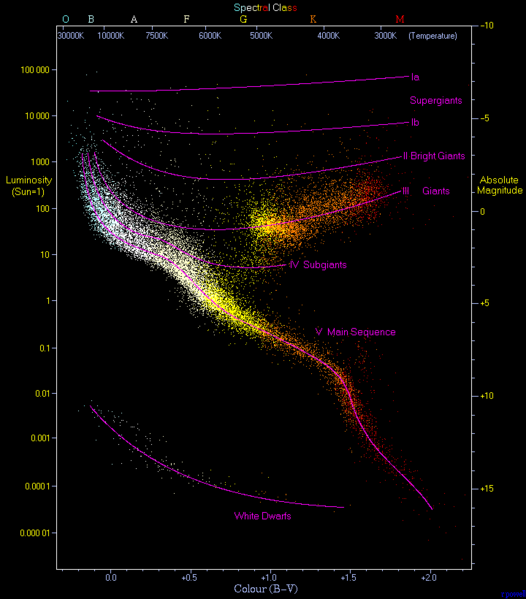
I don't mind if most people don't know what the suns life cycle is, or how the colour and temperature of stars are linked, or if anyone has seen, heard of or understands the H-R diagram or stellar spectra, that's ok. but I do think we should all know at least, which part of a telescope to look through. Sure it might not be obvious at first. But it should be known.

The H-R Diagram.
It tells us about a stars life cycle
While my telescope was being stored ready for its science week appearance with a politician, it had not moved its orientation, even though I know it had been used for a number of photo opportunities during the week. This indicated to me that people were so afraid of moving it and breaking it, that they didn't. Again, a huge lack in their knowledge of how a telescope works! Further, I have a great photo of a federal politician looking through the telescope in the daytime, indoors, pointing up at the roof, with the lens cap on, and using his closed eye! I would love the opportunity to go to Parliament and give a quick tutorial on how to use a simple amateur telescope.

If I present someone with microscope, I'm pretty sure they're not going to try and look up the lens the wrong way. So why did 9 out of 10 people look through the wrong part of a telescope? The answer is I think simple...No one has shown them. A major part of Science is observations, and if we can't get that right, or we have never been shown how to use simple instruments to help us with these observations, then we really need to try harder at science education.

While I was teacher I would often get the question during a student experiment, "Is my observation right?" A fascinating question! My answer was always, "It's your observation, you observed it, record what you saw." It seems as though our observation skills are very poor, and our understanding of equipment to assist in our observations is also poor.

I'm not blaming people for not knowing, but I am inspired to do more science education because of it. It has renewed my enthusiasm to share my passion for science. If I can be the one that shows as many people as possible how to use a telescope, and to not be afraid of it, and actually excited about it, then that'll make me happy! And if you don't know how to use a telescope, please ask me, I'd love to show you!

Sunday, April 26, 2015

An Australian Space Policy

Australia is a user of space. We consume it. We've done so for a very long time and we are very good at it. There are some people (myself included) that really think Australia should take a few steps beyond this relationship we have with space, the international space industry and space based technologies. We have a lot people working on space in Australia and we are renowned worldwide for our contributions and ingenuity.


This blog post is what I think an Australian space plan should look like. It is taken from the Space Policy I wrote for the Future Party.

This plan has been developed to take the best ideas from the Australian Academy of Science (AAS) National Committee for Space Science (NCSS), who have studied it, and who know how best Australia can be a part of it.
The three main ideas are:
  1. Adopt expert recommendations of the Decadal Space Plan from the National Committee for Space Science.
  2. Create an Australian Space Agency, ASTRA
  3. The Woomera launch facility
1. The Decadal Plan 
The plan's vision is ‘Build Australia a long term, productive presence in Space via world-leading innovative space science and technology, strong education and outreach, and international collaborations’. The plan has 14 recommendations with five key imperatives in mind:
Spooky Dish
The Parkes Radio Telescope
Photo Credit: Tom Gordon
  • Enable Australia to develop a strong space industry, and offset the risks of depending primarily on foreign space capabilities.
  • Position Australians to solve major scientific and technological problems.
  • Actively nurture, coordinate, and manage Australia’s investment in space science.
  • Leverage increased public investment in space science.
  • Provide government, community and business with the information needed to guide investment in space science and technology.
The plan document outlines the importance and current status of space science in Australia, and the specific scientific goals of the Australian space science community the next decade and build on our strengths.
With a very large group of experts in their field of astronomy and space science, and a sizeable group of experts from industry and business. I would like Australia to be a place that is known for not only its innovation with existing space based technologies but also an innovator in the field and a provider of world class facilities and programs.

The decadal plan seeks to establish government, commercial, industry and public collaborations to better develop and strengthen our niche technologies in order to be a contributor to the international space industry. 
There's even a cheeky reference to creating Australia's own space agency (like NASA) in the plan. I'd like to go that extra step and I'll come to that now.


2. ASTRA: Australia’s Space Agency
ASTRA (Australian Space Technology & Research Agency) will serve many purposes including:
Spooky Dish
Australia from Space
Photo Credit: NASA [CC BY 2.0], via Wikimedia
  • Developing a strong, internationally recognised, Australian space capability.
  • Create partnerships of Australian and international government and private stakeholders such as NASA, CSA, ESA,JAXA and SpaceX for example.
  • Provide strong economic, educational, government, and strategic benefits to Australia.
  • Provide structure for further research into space and space-based technologies.
Space provides exciting opportunities for humanity to advance itself. Technological development occurring in space research and related fields has already provided us with new technology in the fields of communication, transportation, energy, physics and biology as well as some amazing spin-offs from space-based technologies. Some of these technologies are used regularly by people all over the world.

I think that Australia has the potential to be a hub of space investment and technological development. To do so, however, would require Australia to make serious plans to invest in space research domestically and to attract investment from abroad. Establishing ASTRA will allow us to collaborate with the other major space agencies (and not major ones) around the world and start becoming a part if the conversation and benefit from those membership.

3. Woomera Launch Facility

Australia’s launch facility at Woomera in South Australia will once again become world leading, open to governments and commercial groups wanting to use the facility.
Spooky Dish
Launch Area 6. Woomera, South Australia
Photo Credit: Max Ryan

The conditions are perfect for this redevelopment (images of the phoenix rising out of the ashes are invoked here!) due to recent technological developments in the space industry such as reusable launch vehicles that would benefit greatly from a vast area to land.

The Woomera Launch facility is a largely flat, featureless, quiet electromagnetic and vast terrain of 124 000 km2 the largest landlocked range in the world, approximately the size of England, which allows easier access for test object recovery (an important safety feature for launch activities). Rainfall is rare, and the climate is generally warm and dry. 

The stable conditions virtually assure the ability to conduct year-round operations, with little downtime.
Although Woomera isn’t as close to the equator as some launch sites, (the issue being the further from the equator you are the more speed, or delta-v, you need to get to the right orbit) this is out weighed by the fact that a launch can almost be guaranteed and launch insurance considerations, time and costs will dramatically decrease.

The town of Woomera, meaning spear thrower, is perfect for redevelopment into a support community for the launch facility with heavy influence from Industry, instrumentation, education & research, technologies and services. You have heard of charter cities, well Woomera would be a perfect candidate for that!


Conclusions

Australia is currently a user of space and space based technologies. We have good relationships with countries that have big and exciting space plans and projects and we let them spend their money on those things. However, I think believe our chance and indeed our duty to become a formal member of that group has arrived. We too must spend our money, and of course reap the benefits of that investment into the future!

Technologies are moving so fast, and although we contribute to the efforts and have some world class researchers and industries here, there is a chance to gain some national benefits from actively contributing and supporting the international space industry with our resources, expertise, facilities and ingenuity.

With such an impressive number and quality of experts in their fields and in the space industry, it is imperative that we listen to them and trust their evidence backed advice and recommendations. This, together with some future thinking and planning, Australia’s place in the space industry will be worthwhile and beneficial.

Monday, December 1, 2014

EduTweetOz

Last week I was the curator of the rotation twitter account, @EduTweetOz. Here's more about them

It was a very cool experience. I'm now very used to typing things in 140 characters, which is why this post will be so short!

Anyway, wanna have a look at what I said, what we talked about??

Here's the Storify of my week.

Monday, October 20, 2014

The pendulum of science engagement swings back and forth

I saw this article in the Sydney Morning Herald and just had to have my say!

I disagree with the engaging students with the Miley Cyrus wrecking ball pendulum idea! In the same way that i disagree that the TV show The Big Bang Theory teaches science, It doesn't! At best it starts a discussion about science that includes more people. I would never use TBBT or wrecking ball to teach physics in class, but I would use it to talk about issues in science.

My answer to how we make science engaging, is to do real science, and stay true to what that is. As soon as we water it down (or my most disliked version of that ’dumb it down’) we change what science is. We can not get people interested in science if we tell them what we think they want to hear and then change it once they are engaged.

Students are smart, as soon as you start trying to teach them things using stuff that they think is cool, it is instantly, by definition, uncool and therefore even less engaging!

We do this in High school and it frustrates me so much. We give students band 6 in science, then when they get to uni, they think they are good at (hey, we gave them a band 6!!) but they figure out that science is very different to what they thought it was! No wonder they’re disengaged!

It’s the academic equivalent of asking a kid if they want ice-cream, then when they say yes, we give them a block of frozen cream (which is interesting, but in a different way).

We have to teach science to be what science is! Not an explosion filled, super entertaining bonanza…cos it isn’t that. Sometimes science is not fun. When an explosion happens in science, it is generally the wrong thing, in fact we spend a lot of time trying to stop or at least control explosions. Science is challenging, in the good way. People ask me all the time, is physics hard with all the maths? and my answer is Yes! it is, but it’s a lot harder without it!

I’ve know some great teachers that are engaging their students by being passionate about something and sharing that with their students. One guy has doubled his year 11 science class size in 2 years and NONE of them have dropped for year 12, simply by teaching something that he really likes. By the way it’s a girls school, and he is getting them to rebuild a mini, and run a car show!

One of the best science experiments I saw from a student (a VERY disengaged year 9 student) was she asked her family/friends to do the learner driver exam and she compared the results of younger people with older people. It was an excellent project. Her conclusion was younger people are better drivers (they scored better on the test). This is where the learning happened, we discussed if you could make that conclusion from the data, which you can not. Not only did she learn something about the scientific process/variables/validity etc, but she also told me how she could do the experiment again to get better results! AMAZING! She didn’t go on to do Physics in year 11, but she certainly didn’t hate science after that! I would say that is a successful engagement!

The other cool example is this year when I ran a ”How to be a physicist” session where the students DO science, another disengaged girl said to me in her best year 9 voice. “Thanks, I hated physics before this, but I don’t mind it so much, thanks.” I think you’ll agree, reluctant approval from a teenage student is amongst the highest praise one can be given!

What we should be trying to do is increase the number of people in our ‘club’ not by changing what we’re about, but by inviting others in. The wrecking ball is NOT about simple harmonic motion, so don’t pretend that it is. Like Craig Cormick says in the article, as fan-boys and fan-girls of science we are having a ball doing science, so lets share that excitement and engagement by doing it more, not by doing something else, calling it science and pretending to have fun!

I agree, scientists can be elitist! But so can poetry professors, or politicians, or parents, or plumbers (enough alliteration there??) or anyone! (people!)

If you're after songs that engage people with science, watch any of the clips by the band "OK GO"

Lastly, the point of your article is lost when after the entire speel about scientists being elitist, the last paragraph points out the inaccuracies in the wrecking ball clip, in a very elitist way!

Tuesday, August 5, 2014

PhD justification

Ever since I started working here at the University of Sydney School of Physics in 2011, I have wanted to contribute to my field. I replaced a guy who has a PhD, almost every office I walk past has at least 1 PhD in it, perhaps a few. I'm surrounded by people who's job it is to ask questions. Change one thing, then measure another. Predict, Observe, Explain, etc. I want to do that too! I don't just want to talk about what they do, I want to do it as well. To be able to talk to students, communicate science, with first hand experience.

My field is science communication and education, I have a teaching degree (...mostly) I have been a teacher and for over a decade I've been in the game of learning science and science communication. On arrival, I instantly wanted to become a part of the SUPER group (Sydney University Physics Education Research group). Almost directly after that I was asked to justify the program I run called Kickstart on a number of different metrics, some harder than others to measure.

We say things like, "Kickstart is one of the most successful flagship outreach program of its kind"...How do we know. What are students actually getting out of it? What do they learn, do they like it, Is it good for them, or the teachers?

After a bit of reading and discussing, (some of which I hope to include here later) I came up with the three E's for evaluating Kickstart. This has turned out to be sort of the basis of my projects leading to wards a PhD.

The three E's:

  • Engagement - public awareness of science (PAS)
  • Education - public understanding of science (PUS)
  • Enrolment - public involvement in science (PIS)

Engagement seems to be fairly well understood (I can tell you that students will like the kickstart program! They'll have warm-fuzzy feelings about physics after they leave the lab). Enrolment is very hard to measure, I've tried with a few surveys, (again, I'll write about these later). The second E, Education, is where I start!

My justification for starting a research project such as this is to attempt at asking the questions about Kickstart that most people assume have been asked. Education fits very well into the SUPER group, being Physics education research.

Thursday, July 31, 2014

How to do a PhD

I've begun a journey...to get a PhD.

The PhD project is being done with the Sydney University Physics Education research Group (SUPER group, hands down the best name for a research group if you ask me!) at the University of Sydney. My project will cover different aspects of physics and science education.

This blog will be a sort of research journal, how I did it, what was I thinking, what's next, review of papers/conferences/meetings, data analysis etc. I don't know how any of this works, so I'll be figuring out as I go along. Whoever reads this...You're invited to come along with me!

As with any PhD project, what is presented is only the culmination of all the hours and years put together in a single document. When I was a fresh first year, I remember handing in my very first philosophy assignment. An epic 2500 words essay on something very important like socks with holes in them.
John Locke proposed a scenario regarding a favorite sock that develops a hole. He pondered whether the sock would still be the same after a patch was applied to the hole, and if it would be the same sock, would it still be the same sock after a second patch was applied, and a third, etc., until all of the material of the original sock has been replaced with patches - from Wikipedia.
I remember handing over my masterpiece for which I toiled over, wiping the sweat from my forehead, I could barely walk due to the effor that this essay took, I was a shell of a student, I'd done it, my first university assignment! I was very proud. The lady at the admin counter handed me a receipt of submission and I held onto that thing very tightly, I wanted to say "When do I get notified that this paper will be published and in which well respected journal? I'll be in the refectory if the media need to contact me!"

Next to me, was another student handing something in, but hers was a little bit different. just after my receipt was given I saw 3 entire hardcover books get slammed onto the counter, it made a huge thwop noise!! She looked beat! She simply said, theres three years of my life!" It was her PhD thesis. My jaw dropped. It didn't get any better when all she got for it was the same receipt from the admin lady. I instantly felt, the change in perspective that it almost made me dizzy! I still have no idea how she did that.

I guess no-one can really tell me how they did it, I just have to get in and do it! I don't even know where to start, let alone how to complete and finish it! So I may as well just start! So to answer the question of how to start a PhD?...Like this!

Why!

I was told once by someone finishing up his PhD in Astrophysics a couple of years ago, "You always have to remember why your doing a PhD." You'll forget it sometimes, and it'll seem a long way away, there'll be times when you want to give up, and times where you can't sleep cos you're so excited. But no matter what, you have to have in your mind why you are doing this, and getting to call yourself Doctor is not a good enough reason!

My reason, I want to contribute to the area that I have chosen as my work. I work in science communication and Science education. I would like to say that I have made some form of technical, and academic contribution to that field. And that's basically it. I think the nitty gritty of this may change a bit over time but the basis of it will probably stay the same. This is of course a simplified justification and it goes deeper than that, but for now, it fits.

So I guess here ends my first thoughts about it. There's plenty more to go.

Wednesday, July 23, 2014

This post, it's about space...and its about time as well!

Part of my job is to answer questions from High School science teachers, and I love it! These last questions came from a teacher and her year 11/12 students. I thought the questions were good and showed the great depth that some students are thinking at, and also the great interest in science.

I hope I’ve given them justice. This stuff can get quite mind-warpy very quickly!

How do we know how many light-years away we are seeing - as in we have seen stars 13 million light-years away.

Redshift will tell us the velocity of galaxies away from us, then with a calculation as fundamental as c=fλ we can approximate it’s distance. BUT…It’s not a simple as that…of course! There are effects due to our atmosphere, relativity, gravitational lensing, objects in the way, expansion of space etc that get in the way of accurate measurements. 

So, we have to KNOW the distance to  a whole bunch of objects in order to compare that with others. There are a few ways to do this, either with cepheid variable stars, quasars, pulsars, and parallax. There are a couple of satellites that are tackling the problem with parallax that are very interesting. 

Have a look at Hipparcos and Gaia. These two satellites are involved in Astrometry, a very interesting area in astronomy. Literally measuring the stars! The precision is amazing by the way. Gaia can detect a movement of a star of 10 microarcseconds, (or something like that) the equivalent of seeing the length that my hair grows in 10 minutes from a distance of 10 meters. The angle between the smallest division on a protractor is a degree, that’s made of 60 arc minutes, each one of those is 60 arc seconds, and then 10 1000ths of that!

With all of these methods, we can get some very accurate measurements. 

The text book states that when the universe was one second old it was at least 1 light-year across but wouldn't that mean it was expanding faster than the speed of light?

YEP! It’s called inflation, and it is not very well understood! We talk about it as if we know what happened, but we really don’t! (like when we talk about how we know what the universe is made of, when we really only know what 4% of it is made of!) The experiment BICEP2 had a pretty close shave with the answer, but there is still some discussion, and of course we need to replicate the experiment.

Due to the fact that we don't understand inflation, we need to observe it and measure it, once that has happened, we can then start to try and figure out some details. So in order to measure it, we've tried to measure the effects of what that period would've done to the gravitational environment. In short, we're searching for gravity waves

If the universe started to collapse - could you travel fast enough to escape and can you exist outside the universe?

No. The idea of existence outside of a universe is, with our current understanding, non-sensical. If the universe collapsed, so would everything in it. The physical space between galaxies, stars, planets, etc would also collapse. Think of the usual stars (dots) on a balloon. If you deflate a balloon, the balloon also shrinks, the stars don’t move independent of the balloon, and interestingly (and in line with the analogy) the dots also get smaller!

The idea of “outside" the universe is not defined in physics (like dividing by 0, you just can’t do it. The idea of putting things into 0 groups is a non-sensical idea!) Space and time break down, we have no way of describing that condition mathematically or physically.

Wednesday, July 2, 2014

Celebrity scientists

Earlier this year, I blogged about why scientists should not necessarily be treated like footballers. It's here. The basic argument is that scientists probably do not want to be treated like footballers.

A similar conversation came up again in my twitter feed, this time from the SMH. "Australians can aspire to finer role models." This article rose out of the recent media frenzy around a few stupid things being done by footballers. The questions raised is, Why is Todd Carney a household name and not Brian Schmidt, or Elizabeth Blackburn for example, great question!

This falls nicely into the categories (following on) of name recognition and role models, and with a special request of ticker tape parades as a celebration of both!

Our very own household name, celebrity
 role model scientist, Dr Karl. Apparently
 he gets stopped an average of 2 times
per grocery shop for a question or autograph.

Name recognition
These days, when it comes to name recognition in the media cycle, I don't think that means much. Sure I can name the guy who wee'd into his own mouth now, but gimme two weeks or so and I'll have forgotten it. This works for the scientists as well. During their brief time, scientists could probably be named in households, but only for that brief time. To claim that Todd Carney is a household name and scientists aren't is quite simply not true. That's not how the media works.

To be honest, I'm pretty sure scientists wouldn't want to be household names, if the criteria for being a household name was disgracing yourself and your family. Think of all the household names in the media cycle at the moment, Todd Carney, Rolf Harris, Andrew Coulson.

There was a fantastic documentary series from the BBC called Howard Goodall's Story of Music. In it, the presenter, Howard Goodall, made the point that we know about artists like Beethoven and Chopin, Vivaldi and Wagner for a reason, they were brilliant and did something that no one else did. I think the same can be said for sportspeople like Maradonna or Michael Jordan, and scientists like Marie Curie, Albert Einstein and Isaac Newton. Granted, John O'Sullivan, Brian Schmidt and Rosalind Franklin aren't household names, but Wi-Fi, Dark energy and DNA are!

Role Models
The role of a role model I think is not understood by the role models very well. There are plenty of examples of poor role models that really should know better. The fact that people look up to you and therefore will listen to what you say and watch what you do, should inform some actions. Of course that isn't the case all the time. I think that if people can't handle that, they really shouldn't be role models anymore, and should get out of that position.

A great sporting role model for me was John "Nobody" Eales. After a game of rugby for his country he'd hit the showers, get into a suit and go and delivery a keynote address at a dinner somewhere. Imagine some of the thugs that play football these days doing that!! Being a role model is a responsibility. People like Katie Perry must know that what they do is watched (and copied) by millions around the world.

But due to the above argument about our short attention span for name recognition, even if todd Carney is a role model, how probably won't be for very long. Again, those that are, like (for me) my father, Dr Karl, ex-bosses of mine Pete Mascini and Rachel Dash to name a few, are still role models for me because they've done something different or brilliant etc.

Having been a teacher, which is effectively a role model in many ways, I can tell you that my actions were heavily modified. I was aware that many actions were being watched and acted accordingly. I think that is responsible. Todd Carney must know he is a role model of sorts. People watch what he does because of who he is. No amount of drunkenness can remove that fact that people watch, are informed by, and in some cases, imitate what he does.

As always, there are two sides to the story. We could do better at what we produce in the news and media cycle, we could choose our role models better, we could train them to be better role models. But we should also expect more of our media to provide us with news that is news, and not just shocking "entertainment." And we should certainly expect more from our role models. It is a responsibility to behave morally and correctly (whatever that is!) as a role model. Children look up to you. If you don't think children should witness you doing something...don't do it.

Ticker Tape parades
I've never been to a ticker tape parade. I would probably never go to a ticker tape parade for a sportsperson, but probably would've been there for the Mercury and Apollo astronauts in their day. And I would certainly go to a similar science based celebration like a lecture by Brian Schmidt (and I'd still get chuffed when he remembers my name!). I still really love going to the Eureka Science prize award night, The Oscars for Science! That is a wonderful and huge and shameless pat ourselves on the back event for only us! I love it!

I hope this hasn't gone into rant territory. I'm still happy to keep the conversation going, like I said in the previous post, there's more in it!

Monday, June 30, 2014

Just like a real scientist!

By Renee Webster @reneewebs

Well, the solstice has passed, we’re almost halfway through the year and here at RSHQ the puns ain’t getting any better (sorry not sorry). Thankfully, Real Scientists is only a little bit about indulging the terrible senses of humour of the admins, and mostly about the awesome work that real scientists like this week’s curator Tom Gordon are doing every single day.
Tom gave us a brilliant run down of the Sydney University outreach program Kickstart, which he runs not only at the university, but all over New South Wales. Kickstart allows physics students to participate in experiments that might not be possible in a high school setting, and gives students a taste of university life and laboratories while still in high school. Tom sees an incredible 25 % of all NSW Higher School Certificate students through this excellent program. He also shared with us several pictures of the Kickstart experiments:
 
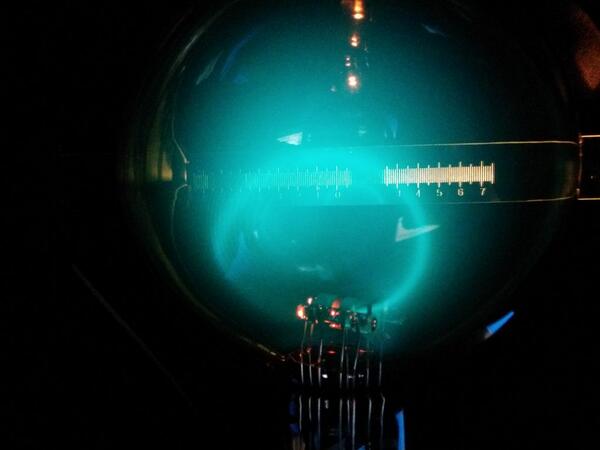
A cathode ray tube, something that’s quickly become closer to a museum specimen than an ever day item students can relate to.
A cathode ray tube, something that’s quickly become closer to a museum specimen than an every day item students can relate to.
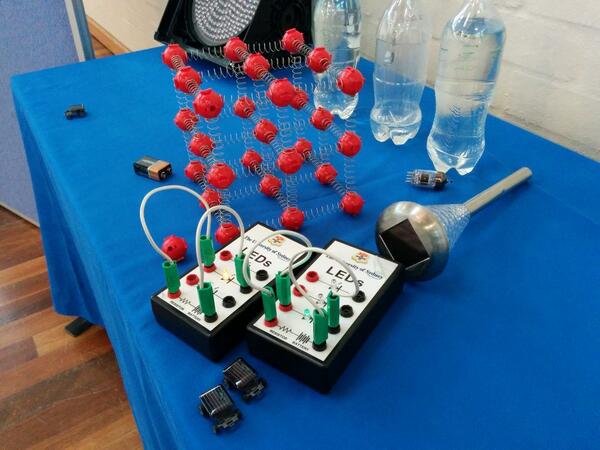
is it an insulator? is it a metal? No! It's a semiconductor!
is it an insulator? is it a metal? No! It’s a semiconductor!
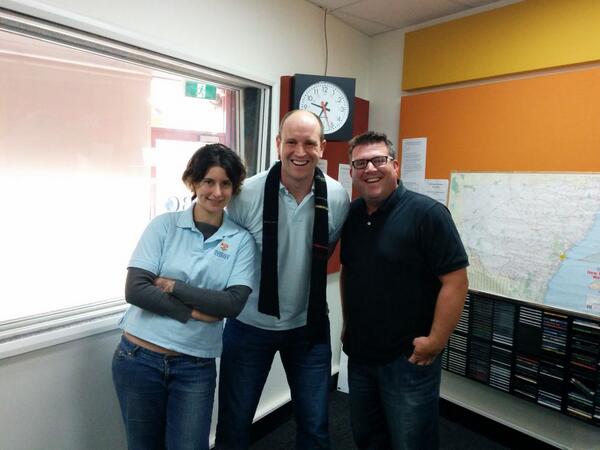
Like a number of other previous curators, Tom took to the airwaves during his time at Real Scientists on ABC Radio Dubbo.
@Gordeauz for all (well 2) of your senses - twitter in your eyes and radio in your ears.
@Gordeauz for all (well 2) of your senses – twitter in your eyes and radio in your ears.
Tom also ran us through his career highlights, from the Questacon Science Circus to behaviour of algae on the Vomit Comet.
An ongoing theme throughout Tom’s week was physics education, and ways we can get students to engage with, and continue studies in physics – including using games in science education. Tom’s even doing a PhD on this so it will be interesting to see how his research in this area progresses.
You can continue to follow Tom’s  adventures in physics and science communication on Twitter, where he is @gordeauz.
We’re trying something new this week, since Storify has been giving us a little bit giant coprolites of trouble. To catch up on Tom’s tweets from this week, click here to see the whole week’s worth of content on the Twitter website. If you have thoughts (proton-like or electron-like) on this new way of collecting each curator’s tweets, please let us know in the comments here, on our Facebook page or on Twitter.

Friday, March 21, 2014

Preaching to the converted

I've been at a few events recently where the sub-theme was pretty clearly "Preach to the converted" Intentional or not, that's what it seemed to be. Even if trying to avoid that sub-theme, it's still there. A few conferences come to mind, as well as a very successful event called IFLScience live.

But Preaching and converted seem to have non-scientific feel about them, so perhaps we should science-ify this saying a bit. Scientists don't really preach. I'd say instead of preaching, we present and review results and collaborate. And we don't call our colleagues converted, we call them peers. So instead of preaching to the converted, it really should be called a process of peer review...
Hang on...Isn't that exactly what Science is???
This process can be seen by some as a bit exclusive or elitist by some but, these are conferences and all conferences are like that, and not just the science ones. It would be a bit silly to invite everyone for the sake of saying everyone is invited. The most recent conference I was at where the vibe felt very self congratulatory was the Australian Science Communicators conference in Brisbane in February this year. And I don't think this is a bad thing. It's good to congratulate ourselves!

What we really should be doing is just including a bigger set of people into our peer group, that's it, just assume that more people are in our peer group! Marketers do this very well. IFLS is about to have this chance to assume that people watching it are your peers when it goes on TV. If we do that, they will become our peers, then they can come to our conferences, get our jokes and be elite like us in the in crowd!

I see program like The Big Bang Theory and others reach out to a science audience, but also to non-science audience, in a way that hasn't been done before. People who laugh at that show (for whatever reason) are now our peers. We can now talk science things with people who would have normally said, "Oh I was never very good at school"and used words like boffin.

For want of a better term, preaching to the converted has its place in what we do. It keeps us thinking about what we do, it makes us feel like we are making a difference (which is important), it allows us to network and catch up with old and new friends (also important) and if done right, will increase the number of converted.

Wednesday, March 19, 2014

Undeniably fact

I'll start this post out as a bit of a response to the article titled "Facts won't beat the climate deniers - Using their tactics will," posted in The Conversation on March 13, 2014 by Dr Rod Lamberts from the Centre for Public Awareness of Science (my old stomping ground!), and we'll see where it takes me.

I like the article, it was a good conversation starter for me. I like Dr Lamberts, he speaks his mind and it is a good mind, I hope he keeps speaking it! and I hope this response is taken is it was intended, as a continuation of the conversation.

First, a quick summary of the article from me.

The facts we as scientists are using to combat the climate deniers are not getting through as we would accept them. We are presented with facts and we get it, they are presented with the same facts and they don't (I'm paraphrasing). Added to that, tactics of opinions and anti-science are getting through. Instead of more facts (the equivalent of talking louder in a foreign country to get people to understand you!), we should be getting in peoples faces with our opinions and point of view. Action, not facts.

This is pretty depressing quote from the article that hit me pretty hard
We can decry climate deniers for their unfair, lowbrow tactics, but their tactics are getting them exactly what they want. Ours are not.
My response.

I think Dr Lamberts has some good points, but I'd like to keep my optimists hat on for little bit longer. I agree with the point about action, Yes, action is what is needed, but it should be action based on facts. I hope this is what Dr Lamberts meant. I don't think we should be forgetting the facts. In fact contrary to what Dr Lamberts said, we should most certainly continue to use facts to inform our arguments. We should of course be loud and proud, we should be getting in peoples faces, but all based on fact. I'll refrain from pulling apart this quote "The fact is that the time for fact-based argument is over" in the same way the Tim Flannery's quote was pulled apart in the article.

I like this quote. I've used it
before, cos it's a good'un.
Credit: dashburst.com
The fact is that facts are true (see Neil deGrasse Tyson quote), Opinions can be true too, but are not always. To ignore this in any argument is silly. Our facts are based on science, knowledge and the scientific process, which has worked pretty well for a few hundred years. I think instead of ignoring facts, we should not only rely on them more heavily, cos you can't deny facts, we should also lean on the process which we use to get those facts.

Dr Lamberts says in his article "Forget the Moncktonites, disregard the Boltists, and snub the Abbottsians. Ignore them, step around them, or walk over them." Again, I agree, as their opinions do not aid in the discussion, but to continue to say the we should use their tactics, I disagree with. (granted it is of course hard to ignore the people who have been elected to make the laws, but it isn't impossible!)

I'm a big advocate of aiming above the lowest common denominator, not at it or below it. Using their tactics is moving to their level that is not based on facts, and arguing without facts is worse, in my opinion, than arguing with facts. In a way, we could be mindfully ignorant of the things that some people just don't know. We could assume that there is a level of knowledge out there about climate change, this would effectively eliminate that discussion. Sure we'll lose some supporters along the way, but we'd also eliminate the need to argue silly points that we have argued many times. I guess this is the same as what Dr Lamberts is suggesting. Forget, disregard and snub!

I think you'll find that our tactics are working. There are of course set backs, but this will always happen. Look at that spectacular video from the Year 9 Newtown High students that asked PM Abbott questions the other day as one example. Those are the people that in a few years will be representing us. We're in good hands if you ask me. These students are not unique either, there are many more with the same tenacity as these guys. There are even political parties that call for evidence based policy, and a high focus on STEM etc. The Future Party and The Greens to mention a couple. I honestly don't think we are losing the battle, so we should therefore not change our tactics.

Sure, let's get loud, and active, but also, let's not forget what we are loud about. We are here to solve a problem that science can solve, and science is based on facts, so lets use those facts that in the long run, will always prevail over opinions, in our argument. Instead of us using their tactics, let's force them to use ours, then we'll really see whose ahead in the debate!

Action with facts. If only the word Faction didn't already mean something else, it would be perfect here!