Monday, December 1, 2014

EduTweetOz

Last week I was the curator of the rotation twitter account, @EduTweetOz. Here's more about them

It was a very cool experience. I'm now very used to typing things in 140 characters, which is why this post will be so short!

Anyway, wanna have a look at what I said, what we talked about??

Here's the Storify of my week.

Monday, October 20, 2014

The pendulum of science engagement swings back and forth

I saw this article in the Sydney Morning Herald and just had to have my say!

I disagree with the engaging students with the Miley Cyrus wrecking ball pendulum idea! In the same way that i disagree that the TV show The Big Bang Theory teaches science, It doesn't! At best it starts a discussion about science that includes more people. I would never use TBBT or wrecking ball to teach physics in class, but I would use it to talk about issues in science.

My answer to how we make science engaging, is to do real science, and stay true to what that is. As soon as we water it down (or my most disliked version of that ’dumb it down’) we change what science is. We can not get people interested in science if we tell them what we think they want to hear and then change it once they are engaged.

Students are smart, as soon as you start trying to teach them things using stuff that they think is cool, it is instantly, by definition, uncool and therefore even less engaging!

We do this in High school and it frustrates me so much. We give students band 6 in science, then when they get to uni, they think they are good at (hey, we gave them a band 6!!) but they figure out that science is very different to what they thought it was! No wonder they’re disengaged!

It’s the academic equivalent of asking a kid if they want ice-cream, then when they say yes, we give them a block of frozen cream (which is interesting, but in a different way).

We have to teach science to be what science is! Not an explosion filled, super entertaining bonanza…cos it isn’t that. Sometimes science is not fun. When an explosion happens in science, it is generally the wrong thing, in fact we spend a lot of time trying to stop or at least control explosions. Science is challenging, in the good way. People ask me all the time, is physics hard with all the maths? and my answer is Yes! it is, but it’s a lot harder without it!

I’ve know some great teachers that are engaging their students by being passionate about something and sharing that with their students. One guy has doubled his year 11 science class size in 2 years and NONE of them have dropped for year 12, simply by teaching something that he really likes. By the way it’s a girls school, and he is getting them to rebuild a mini, and run a car show!

One of the best science experiments I saw from a student (a VERY disengaged year 9 student) was she asked her family/friends to do the learner driver exam and she compared the results of younger people with older people. It was an excellent project. Her conclusion was younger people are better drivers (they scored better on the test). This is where the learning happened, we discussed if you could make that conclusion from the data, which you can not. Not only did she learn something about the scientific process/variables/validity etc, but she also told me how she could do the experiment again to get better results! AMAZING! She didn’t go on to do Physics in year 11, but she certainly didn’t hate science after that! I would say that is a successful engagement!

The other cool example is this year when I ran a ”How to be a physicist” session where the students DO science, another disengaged girl said to me in her best year 9 voice. “Thanks, I hated physics before this, but I don’t mind it so much, thanks.” I think you’ll agree, reluctant approval from a teenage student is amongst the highest praise one can be given!

What we should be trying to do is increase the number of people in our ‘club’ not by changing what we’re about, but by inviting others in. The wrecking ball is NOT about simple harmonic motion, so don’t pretend that it is. Like Craig Cormick says in the article, as fan-boys and fan-girls of science we are having a ball doing science, so lets share that excitement and engagement by doing it more, not by doing something else, calling it science and pretending to have fun!

I agree, scientists can be elitist! But so can poetry professors, or politicians, or parents, or plumbers (enough alliteration there??) or anyone! (people!)

If you're after songs that engage people with science, watch any of the clips by the band "OK GO"

Lastly, the point of your article is lost when after the entire speel about scientists being elitist, the last paragraph points out the inaccuracies in the wrecking ball clip, in a very elitist way!

Tuesday, August 5, 2014

PhD justification

Ever since I started working here at the University of Sydney School of Physics in 2011, I have wanted to contribute to my field. I replaced a guy who has a PhD, almost every office I walk past has at least 1 PhD in it, perhaps a few. I'm surrounded by people who's job it is to ask questions. Change one thing, then measure another. Predict, Observe, Explain, etc. I want to do that too! I don't just want to talk about what they do, I want to do it as well. To be able to talk to students, communicate science, with first hand experience.

My field is science communication and education, I have a teaching degree (...mostly) I have been a teacher and for over a decade I've been in the game of learning science and science communication. On arrival, I instantly wanted to become a part of the SUPER group (Sydney University Physics Education Research group). Almost directly after that I was asked to justify the program I run called Kickstart on a number of different metrics, some harder than others to measure.

We say things like, "Kickstart is one of the most successful flagship outreach program of its kind"...How do we know. What are students actually getting out of it? What do they learn, do they like it, Is it good for them, or the teachers?

After a bit of reading and discussing, (some of which I hope to include here later) I came up with the three E's for evaluating Kickstart. This has turned out to be sort of the basis of my projects leading to wards a PhD.

The three E's:

  • Engagement - public awareness of science (PAS)
  • Education - public understanding of science (PUS)
  • Enrolment - public involvement in science (PIS)

Engagement seems to be fairly well understood (I can tell you that students will like the kickstart program! They'll have warm-fuzzy feelings about physics after they leave the lab). Enrolment is very hard to measure, I've tried with a few surveys, (again, I'll write about these later). The second E, Education, is where I start!

My justification for starting a research project such as this is to attempt at asking the questions about Kickstart that most people assume have been asked. Education fits very well into the SUPER group, being Physics education research.

Thursday, July 31, 2014

How to do a PhD

I've begun a journey...to get a PhD.

The PhD project is being done with the Sydney University Physics Education research Group (SUPER group, hands down the best name for a research group if you ask me!) at the University of Sydney. My project will cover different aspects of physics and science education.

This blog will be a sort of research journal, how I did it, what was I thinking, what's next, review of papers/conferences/meetings, data analysis etc. I don't know how any of this works, so I'll be figuring out as I go along. Whoever reads this...You're invited to come along with me!

As with any PhD project, what is presented is only the culmination of all the hours and years put together in a single document. When I was a fresh first year, I remember handing in my very first philosophy assignment. An epic 2500 words essay on something very important like socks with holes in them.
John Locke proposed a scenario regarding a favorite sock that develops a hole. He pondered whether the sock would still be the same after a patch was applied to the hole, and if it would be the same sock, would it still be the same sock after a second patch was applied, and a third, etc., until all of the material of the original sock has been replaced with patches - from Wikipedia.
I remember handing over my masterpiece for which I toiled over, wiping the sweat from my forehead, I could barely walk due to the effor that this essay took, I was a shell of a student, I'd done it, my first university assignment! I was very proud. The lady at the admin counter handed me a receipt of submission and I held onto that thing very tightly, I wanted to say "When do I get notified that this paper will be published and in which well respected journal? I'll be in the refectory if the media need to contact me!"

Next to me, was another student handing something in, but hers was a little bit different. just after my receipt was given I saw 3 entire hardcover books get slammed onto the counter, it made a huge thwop noise!! She looked beat! She simply said, theres three years of my life!" It was her PhD thesis. My jaw dropped. It didn't get any better when all she got for it was the same receipt from the admin lady. I instantly felt, the change in perspective that it almost made me dizzy! I still have no idea how she did that.

I guess no-one can really tell me how they did it, I just have to get in and do it! I don't even know where to start, let alone how to complete and finish it! So I may as well just start! So to answer the question of how to start a PhD?...Like this!

Why!

I was told once by someone finishing up his PhD in Astrophysics a couple of years ago, "You always have to remember why your doing a PhD." You'll forget it sometimes, and it'll seem a long way away, there'll be times when you want to give up, and times where you can't sleep cos you're so excited. But no matter what, you have to have in your mind why you are doing this, and getting to call yourself Doctor is not a good enough reason!

My reason, I want to contribute to the area that I have chosen as my work. I work in science communication and Science education. I would like to say that I have made some form of technical, and academic contribution to that field. And that's basically it. I think the nitty gritty of this may change a bit over time but the basis of it will probably stay the same. This is of course a simplified justification and it goes deeper than that, but for now, it fits.

So I guess here ends my first thoughts about it. There's plenty more to go.

Wednesday, July 23, 2014

This post, it's about space...and its about time as well!

Part of my job is to answer questions from High School science teachers, and I love it! These last questions came from a teacher and her year 11/12 students. I thought the questions were good and showed the great depth that some students are thinking at, and also the great interest in science.

I hope I’ve given them justice. This stuff can get quite mind-warpy very quickly!

How do we know how many light-years away we are seeing - as in we have seen stars 13 million light-years away.

Redshift will tell us the velocity of galaxies away from us, then with a calculation as fundamental as c=fλ we can approximate it’s distance. BUT…It’s not a simple as that…of course! There are effects due to our atmosphere, relativity, gravitational lensing, objects in the way, expansion of space etc that get in the way of accurate measurements. 

So, we have to KNOW the distance to  a whole bunch of objects in order to compare that with others. There are a few ways to do this, either with cepheid variable stars, quasars, pulsars, and parallax. There are a couple of satellites that are tackling the problem with parallax that are very interesting. 

Have a look at Hipparcos and Gaia. These two satellites are involved in Astrometry, a very interesting area in astronomy. Literally measuring the stars! The precision is amazing by the way. Gaia can detect a movement of a star of 10 microarcseconds, (or something like that) the equivalent of seeing the length that my hair grows in 10 minutes from a distance of 10 meters. The angle between the smallest division on a protractor is a degree, that’s made of 60 arc minutes, each one of those is 60 arc seconds, and then 10 1000ths of that!

With all of these methods, we can get some very accurate measurements. 

The text book states that when the universe was one second old it was at least 1 light-year across but wouldn't that mean it was expanding faster than the speed of light?

YEP! It’s called inflation, and it is not very well understood! We talk about it as if we know what happened, but we really don’t! (like when we talk about how we know what the universe is made of, when we really only know what 4% of it is made of!) The experiment BICEP2 had a pretty close shave with the answer, but there is still some discussion, and of course we need to replicate the experiment.

Due to the fact that we don't understand inflation, we need to observe it and measure it, once that has happened, we can then start to try and figure out some details. So in order to measure it, we've tried to measure the effects of what that period would've done to the gravitational environment. In short, we're searching for gravity waves

If the universe started to collapse - could you travel fast enough to escape and can you exist outside the universe?

No. The idea of existence outside of a universe is, with our current understanding, non-sensical. If the universe collapsed, so would everything in it. The physical space between galaxies, stars, planets, etc would also collapse. Think of the usual stars (dots) on a balloon. If you deflate a balloon, the balloon also shrinks, the stars don’t move independent of the balloon, and interestingly (and in line with the analogy) the dots also get smaller!

The idea of “outside" the universe is not defined in physics (like dividing by 0, you just can’t do it. The idea of putting things into 0 groups is a non-sensical idea!) Space and time break down, we have no way of describing that condition mathematically or physically.

Wednesday, July 2, 2014

Celebrity scientists

Earlier this year, I blogged about why scientists should not necessarily be treated like footballers. It's here. The basic argument is that scientists probably do not want to be treated like footballers.

A similar conversation came up again in my twitter feed, this time from the SMH. "Australians can aspire to finer role models." This article rose out of the recent media frenzy around a few stupid things being done by footballers. The questions raised is, Why is Todd Carney a household name and not Brian Schmidt, or Elizabeth Blackburn for example, great question!

This falls nicely into the categories (following on) of name recognition and role models, and with a special request of ticker tape parades as a celebration of both!

Our very own household name, celebrity
 role model scientist, Dr Karl. Apparently
 he gets stopped an average of 2 times
per grocery shop for a question or autograph.

Name recognition
These days, when it comes to name recognition in the media cycle, I don't think that means much. Sure I can name the guy who wee'd into his own mouth now, but gimme two weeks or so and I'll have forgotten it. This works for the scientists as well. During their brief time, scientists could probably be named in households, but only for that brief time. To claim that Todd Carney is a household name and scientists aren't is quite simply not true. That's not how the media works.

To be honest, I'm pretty sure scientists wouldn't want to be household names, if the criteria for being a household name was disgracing yourself and your family. Think of all the household names in the media cycle at the moment, Todd Carney, Rolf Harris, Andrew Coulson.

There was a fantastic documentary series from the BBC called Howard Goodall's Story of Music. In it, the presenter, Howard Goodall, made the point that we know about artists like Beethoven and Chopin, Vivaldi and Wagner for a reason, they were brilliant and did something that no one else did. I think the same can be said for sportspeople like Maradonna or Michael Jordan, and scientists like Marie Curie, Albert Einstein and Isaac Newton. Granted, John O'Sullivan, Brian Schmidt and Rosalind Franklin aren't household names, but Wi-Fi, Dark energy and DNA are!

Role Models
The role of a role model I think is not understood by the role models very well. There are plenty of examples of poor role models that really should know better. The fact that people look up to you and therefore will listen to what you say and watch what you do, should inform some actions. Of course that isn't the case all the time. I think that if people can't handle that, they really shouldn't be role models anymore, and should get out of that position.

A great sporting role model for me was John "Nobody" Eales. After a game of rugby for his country he'd hit the showers, get into a suit and go and delivery a keynote address at a dinner somewhere. Imagine some of the thugs that play football these days doing that!! Being a role model is a responsibility. People like Katie Perry must know that what they do is watched (and copied) by millions around the world.

But due to the above argument about our short attention span for name recognition, even if todd Carney is a role model, how probably won't be for very long. Again, those that are, like (for me) my father, Dr Karl, ex-bosses of mine Pete Mascini and Rachel Dash to name a few, are still role models for me because they've done something different or brilliant etc.

Having been a teacher, which is effectively a role model in many ways, I can tell you that my actions were heavily modified. I was aware that many actions were being watched and acted accordingly. I think that is responsible. Todd Carney must know he is a role model of sorts. People watch what he does because of who he is. No amount of drunkenness can remove that fact that people watch, are informed by, and in some cases, imitate what he does.

As always, there are two sides to the story. We could do better at what we produce in the news and media cycle, we could choose our role models better, we could train them to be better role models. But we should also expect more of our media to provide us with news that is news, and not just shocking "entertainment." And we should certainly expect more from our role models. It is a responsibility to behave morally and correctly (whatever that is!) as a role model. Children look up to you. If you don't think children should witness you doing something...don't do it.

Ticker Tape parades
I've never been to a ticker tape parade. I would probably never go to a ticker tape parade for a sportsperson, but probably would've been there for the Mercury and Apollo astronauts in their day. And I would certainly go to a similar science based celebration like a lecture by Brian Schmidt (and I'd still get chuffed when he remembers my name!). I still really love going to the Eureka Science prize award night, The Oscars for Science! That is a wonderful and huge and shameless pat ourselves on the back event for only us! I love it!

I hope this hasn't gone into rant territory. I'm still happy to keep the conversation going, like I said in the previous post, there's more in it!

Monday, June 30, 2014

Just like a real scientist!

By Renee Webster @reneewebs

Well, the solstice has passed, we’re almost halfway through the year and here at RSHQ the puns ain’t getting any better (sorry not sorry). Thankfully, Real Scientists is only a little bit about indulging the terrible senses of humour of the admins, and mostly about the awesome work that real scientists like this week’s curator Tom Gordon are doing every single day.
Tom gave us a brilliant run down of the Sydney University outreach program Kickstart, which he runs not only at the university, but all over New South Wales. Kickstart allows physics students to participate in experiments that might not be possible in a high school setting, and gives students a taste of university life and laboratories while still in high school. Tom sees an incredible 25 % of all NSW Higher School Certificate students through this excellent program. He also shared with us several pictures of the Kickstart experiments:
 
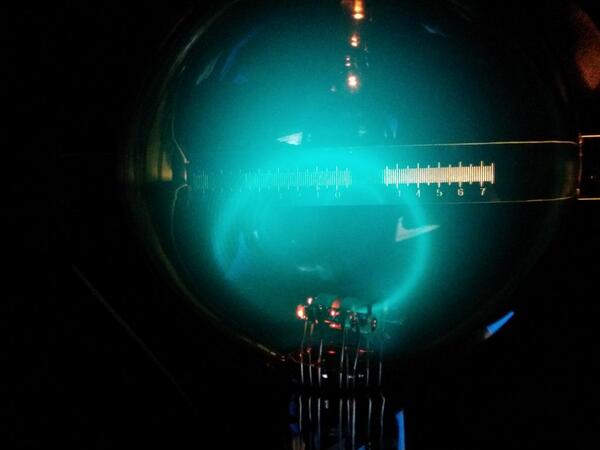
A cathode ray tube, something that’s quickly become closer to a museum specimen than an ever day item students can relate to.
A cathode ray tube, something that’s quickly become closer to a museum specimen than an every day item students can relate to.
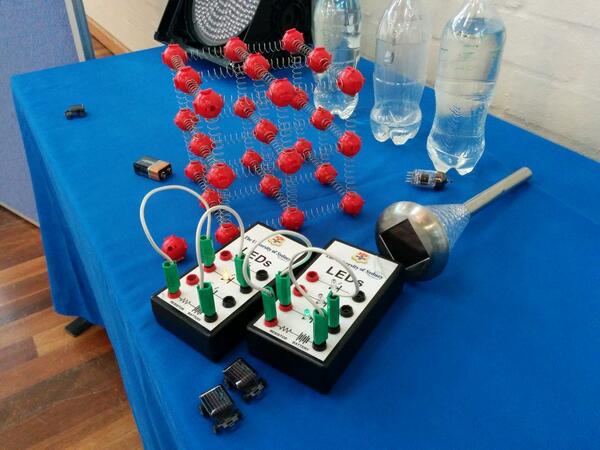
is it an insulator? is it a metal? No! It's a semiconductor!
is it an insulator? is it a metal? No! It’s a semiconductor!
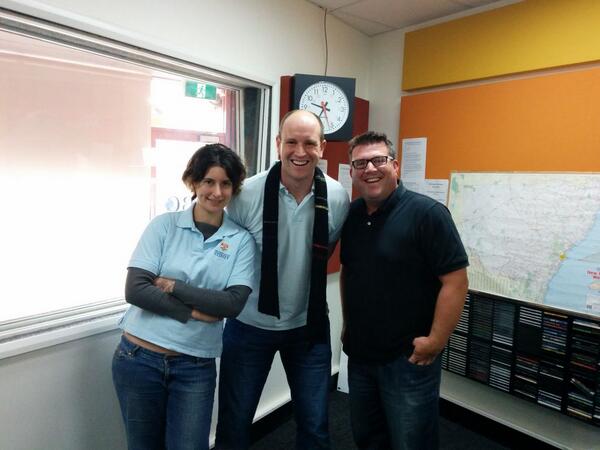
Like a number of other previous curators, Tom took to the airwaves during his time at Real Scientists on ABC Radio Dubbo.
@Gordeauz for all (well 2) of your senses - twitter in your eyes and radio in your ears.
@Gordeauz for all (well 2) of your senses – twitter in your eyes and radio in your ears.
Tom also ran us through his career highlights, from the Questacon Science Circus to behaviour of algae on the Vomit Comet.
An ongoing theme throughout Tom’s week was physics education, and ways we can get students to engage with, and continue studies in physics – including using games in science education. Tom’s even doing a PhD on this so it will be interesting to see how his research in this area progresses.
You can continue to follow Tom’s  adventures in physics and science communication on Twitter, where he is @gordeauz.
We’re trying something new this week, since Storify has been giving us a little bit giant coprolites of trouble. To catch up on Tom’s tweets from this week, click here to see the whole week’s worth of content on the Twitter website. If you have thoughts (proton-like or electron-like) on this new way of collecting each curator’s tweets, please let us know in the comments here, on our Facebook page or on Twitter.