Showing posts with label slyence. Show all posts

Friday, January 24, 2014

SN 2014J

What a week for astronomy! Another example of why we should look up...even in London...on a cloudy night.

I tell students I talk to all the time that science can be done by anyone, even them. Next time you're in a classroom and something is odd, or not expected, have a look at what could be happening, because in some cases, like the discovery of a new supernova, it could be new science.
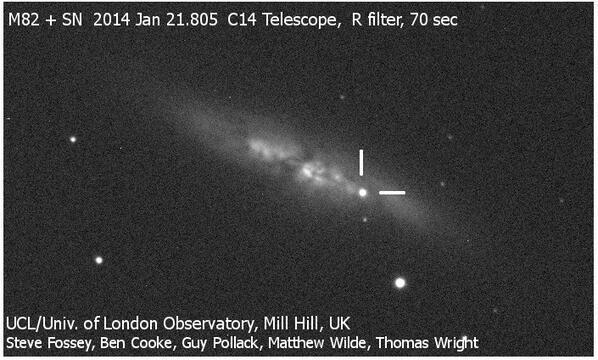
Supernova 2014J. It'll get brighter over the next couple 
of weeks.


Steve Fossey, an astronomer at the University College London was giving a quick 10 minute lesson to his students on the use of CCD cameras in astronomy, before the clouds in London rolled over. They pointed theirtelescope at the object M82, otherwise known as the cigar galaxy and saw something that "...didn't quite look right"
"One minute we're eating pizza then five minutes later we've helped to discover a supernova. I couldn't believe it," said student Tom Wright "It reminds me why I got interested in astronomy in the first place"
The more you look into this story the better it gets. I don't really want to report on all the things that have already been reported, but comment on the situation of students finding the Supernova, the unexpected circumstances and what to can mean for science, science education and awareness.

There is that old adage that scientific discoveries or less commonly followed by the phrase "I knew it" and more by "That's odd." That is almost certainly not exactly true, we scientists know what we are doing (especially if you read grant proposals!!) but we do see some strange results from time to time. Some people call it the Eureka moment, some call it frustrating, some call it their lifes work.


Hans Christian Oersted  immediately came to mind when I heard about the teacher discovering a Supernova this week. Oersted, in 1820, was lecturing on electric current through a wire, noticed that a nearby compass deflected when the current was switched on and restored to its original position when the current was switched off, making a link between electricity and magnetism. We take it for granted now almost.


I love the line "It reminded me why I got into astronomy in the first place. YES! Me too! It makes me want to go out right now and look up at the stars, but I can't because it's raining.  Although that just makes me want to get a radio telescope!

I hope this inspires a few people to one of a whole range of different things. 
  1. To consider science as a real living breathing thing that we are witnessing changing right now.
  2. That Astronomy is really exciting. Seriously, if it wasn't Steve Fossey and his students, it could've been anyone who discovered it
  3. Get involved in amateur astronomy, get a telescope, join a club even just look up and try and familiarise yourself with the night sky.
  4. Find out more and talk to others about Supernovae, or this event
This supernova is going to tell us a lot more than we already know about our universe and it is exciting to se it happen and see it talked about. I'm certainly going to keep my eyes open.

Unfortunately for us in the southern hemisphere, we wont be able to see it, but keep your eyes out in the blogosphere and news for some spectacular pictures. We have already asked those in the north to take some snaps for us, they said they'll do their best! And if you get inspired enough and you want to know more (formally), contact your local astronomer. I know a few, I can put you in touch!

Friday, November 1, 2013

Half-life cake


The half-life cake is a bit of science that happens in most offices, staff rooms, boardrooms and committee meetings around the country. And probably a lot of social functions as well. It's beautiful bit of science often overlooked. At most, in the places I have worked, it's noted and laughed at but no more than that. I think the half life cake should be celebrated, this is my attempt to celebrate it. What better way to celebrate than with cake!

When a cake is presented at a work function or event, it is generally cut up into eight pieces. An eighth of a cake is not too big of a piece and also not to small. Knowing full well that there are more than eight people to give some cake to, cakes are still only cut up into eight. This has always amused me!

And of course, those fairly sizeable pieces of cake go quite quickly. but only seven of them! The last one is always left over. Nobody wants to be the person to eat the last cake. there must be some unwritten rule that you can't eat the last bit of cake. But because there are some people who haven't had cake (or some that might want more), they'll cut it in half. You have to cut it in half, you can't go less than that, because you want as much cake as possible and you can't go more than half, that's greedy. So we are left with one sixteenth of the original cake left. Then another cake eater wants their slice, so they'll repeat the process. They're happy cos they have cake and they didn't finish the cake, and we have 1/32 of a cake left. A third person repeats this, and at this stage, the cake consumers are getting frustrated, their cake ration is diminishing, and the (depending on the cake) cake's structural integrity is being compromised.

What we are seeing is the decay of the cake over time. Each time period, half more of the cake has decayed into someone's mouth. Theoretically, and interestingly, if we were to keep at this, it would take avery long time to actually have no cake left, we would have to get down to a single molecule or atom of cake, (I forget which number in the periodic table cakium is...) before someone would have to eat the last bit.

In science we don't use this as a measure of how annoying it is to cut up really small bits of cake, we use this as a time measurement.I know that every time someone goes to grab some more of the last bit of cake, they'll cut it in half. leaving half left over. that means that in one time period, or iteration, the piece of cake has halved its size. So the next time someone goes for cake (the second iteration) it will be half that again, or one quarter it's original size. It'll be an eighth the original size after three iterations, a sixteenth after 4 etc...This time measurement is called the half-life.


Why is this useful? It's useful because as I said before, we would be here for a very long time in order to figure out how long takes for things to completely disappear. In fact with radioactivity it is impossible to figure that out, due to that fact that this process is not only almost infinite but completely random. So in order to make sense of how long a cake will last (which is an unanswerable question) we ask how long until one half of the cake has gone. That we can answer!

If each iteration of the cake decay was about 5 minutes, we would say that the half life (that is, the time it takes for half the cake to decay, is 5 minutes! Easy. You can even see that on the graph. If you go to the amount of cake of 0.5. You'll see that the corresponding value on the x-axis to that is 1 (where 1 iteration is equal to 5 minutes). I could even ask you how much cake will be left after 15 minutes? and you would say "according to your graph...0.125 of the original piece" This is a much better answer to the questions of how long will it take fort hat cake to go away. Much better to give a number as an answer rather than, "Forever." Some cakes will have much longer half lives than others. This will give us an indication of it's stability or rate of decay. A cake that decays very quickly is unstable.

Like cakes, elements are radioactive too, some elements decay faster than others, and some take thousands of years. Due to the fact that half-life decay os very predictable, even though when each part of the element will decay is completely random, we can make some very precise measurements of how old something is, based on the amount of radioactivity it has left. This'd almost be like judging how good a cake is based on how much of the last slice is left after a certain time.

So I have either inspired you to regard the cutting of the cake in a new way, impressed you with another place where great science can be found, and maybe even educating you a bit about half-life, or I have way too much time on my hands and think about this stuff too much. Either way, the cake, in this case, is not a lie.

Horse racing

As mentioned in a previous blog post about climate science, I really don't like horse racing. It's physical and emotional abuse of horses at best. Here are my thoughts from that post:
"I can't stand horse racing. It's simply justified animal abuse in my opinion. If I were to hit you with a whip to make you run faster, I'd surely be done for physical abuse! I've been told however that jockey's don't always hit horses, they pretend to hit them most of the time...which is worse! If I was to pretend to hit you with a whip in order for you to run faster, I could be done for emotional abuse."
I'd like to add to that little rant with this. If there was no-one betting on which horse would win, it wouldn't be a very popular sport, which, by extension, means that the only reason this sport exists, is for gambling, which makes it less like a sport, and more like...gambling! To make some people very rich, and others very sorry that they wasted their money.

Horsehead nebula. We use parallax
to measure Astronomical distances
The only good thing about horse racing is that it uses (or used to) parallax at the finish line to determine the winner of the race. parallax is a very important concept in science and it seems to be left out of a lot of places.

So what is parallax?

Parallax is the observation a fixed object from different perspectives in order to calculate its distance from the observer. The best example is to do it yourself. Put your thumb up and extend your arm out. Make your thumb over up something on the other side of the room, a clock, or light or something and close one eye (it doesn't matter which one). Now keeping your thumb where it is, open the other eye and close the one that was just open. Your thumb has now 'shifted' and it is no longer covering the thing you originally covered. This is parallax. Your point of observation move, therefore the object you were observing appeared to move. With some very simple maths and similar triangles we can calculate how for away the light (or clock...or whatever) is, based on the length of your arm and distance between your eyes.

This is how we measure astronomical distances. We assume that the stars that are a very long way away, don't move much (they do but we don't see it) and we measure a stars position in the night sky in January, then again in July, when the Earth is on the other side of the Sun. the distance that the stars relative position has changed tells us how for away it is. Cool!

The point is though, that if you change where you observe from, you will change your measurement. This is where parallax error comes in. If I measure a volume of liquid standing up, then the same volume of liquid while I am sitting, I'll be observing the liquid from different perspectives therefore giving a different result. Not good!
Japan World cup 2. Horse racing done right!

It's exactly the same with Horse racing. Two people can have different opinions of which horse won a race depending on where the saw the finish line from. Even if they were both next to each other, they would still see the result differently. To get around this, we use a mirror at the finishing post of a horse race.

The mirror helps us eliminate parallax error. The way we do this is to line up the horses nose, with the image of the horses nose in the mirror. When the two things line up, we know for sure that we are looking at the finish post straight on and that will tell us which horse finished first. Lining the object and the image of the object makes sure that we are not changing our perspective. This technique is used in physics all the time to either measure the distance to something, or eliminate observational error.

So next Melbourne cup when we are all experts on horse racing, you'll find me talking about parallax, not the odds of some animal that we make run fast in winning money for us. If I ever owned a horse, I think I'd call it Parallax Error!

Sunday, October 13, 2013

Beer

As I was sitting here at my computer, taking a sip of my cool, refreshing beer on this hot night, trying to formulate some ideas on what physics is, then BAM, unexpected physics happens! I love it!

I've heard once that Carlsberg beer owns a majority of the Danish Royal Academy, so I decided to find out.

It turns out that it's not the case, but it isn't far off and the story is pretty cool. This is my very brief rundown. So go get a Carlsberg and enjoy the story.

Carlsberg brewery was founded by J. C. Jacobson in 1844 and named his brewery after his son Carl. Jacobson was a lover of science, politics, art and knowledge. He realised that beer should be industrialised and beer prodcution should be based on scientific methods. I Agree!

In 1876, the Carlsberg Foundation which was to have "firm obligations to the natural sciences" was formed in order to fund the Carlsberg Laboratory.  Jacobsen stated that the foundation should always own 51% of the brewery, but through interpretation this is more like 81% (depending on how you count). This 51% was the genesis of the "majority of Danish Royal Academy owned by Carlsberg" thing. It wasn't quite the Royal Academy, but they are in the same building!

The Carlsberg Laboratory was set up to "advance the biochemical knowledge especially relating to brewing", and it has certainly done that. Two pretty neat things that have come out of the Carlsberg lab are:
  1. The production of a pure yeast, saccharomyces carlsbergensis, used in the production of lagers basically eveywhere, 
  2. The development of the pH scale used in chemsitry by one of the Carlsberg labaroatory directors, Sorenson.
So, Carlsberg brewery set up a foundation to support and fund a labaratory that has produced some of the most important discoveries in science, all in the name of beer! It really is the beer of science.

The Carlsberg lab really has made a pretty big contribution. There are even links to Oersted, Hans Christian Anderson, Neils Bohr and many famons Dutch people. 

I like to think of it as drinking to fund science research.

To Science! Cheers!

Sunday, September 22, 2013

Teaching


As a teacher, I found myself on a few occasions teaching things like common sense, or how not to be foolish to some students more than science.

Teachers have an arsenal of classroom management techniques, some of mine included stopping what activity was being done and write things from the board, swapping groups, moving onto next activity, distraction, you know...the usual.

I realised however, that I was in a science classroom and I can use science to change the activity yet still using the topic or concept to say "Hey guys, get back on track," as well as "check this out, it's science, it's relevant"

Here are 3 examples of my science classroom management techniques where I got to investigate relevant science concepts as well as get the class back on task.

1. Peripheral vision
In a year 8 anatomy class, I noticed in my peripheral vision, some students were being less that model students. I stopped the activity and got them all to sit down. I asked the students to show me their best spirit fingers with their hands either side of their head about where their ears are, so that they couldn't see their hands. I asked the slowly move their hands forward (while still giving it some sparkle) until they could see their hands still looking forward.


Firstly, it is pretty amusing to see a whole class of year 8 students doing spirit fingers, and secondly, they have instantly realised that their peripheral vision is quite wide...and so is mine! I barely had to mention the fact that I could see what those students were doing. The message was effective and I got to talk about science in the process.

2. Total internal reflection
Very similar situation, but instead of using jazz hands, I used the door to the classroom that had a large glass panel in, opened in a way such that through total internal reflection, I could see what some of the students were up to. So, in a physics class on the properties of light, I could stop the class, talk about total internal reflection, then simply turn to the door and wave at the students behind me reflected from the door. Again, I didn't even need to mention the classroom management point of the excersise, that was fairly obvious, and so was the scientific one.

3. Waves
This technique wasn't really about showing the students they had done something wrong, just disrupting their disruptive behaviour. In the waves topic, I would get the students to create a mexican wave in class, complete with shouting etc! The beauty of this is that there are heaps of things like reflection, interference, refraction, speed, transverse vs longitudinal that you can do with waves. So each time I had to use the technique (which worked in terms of classroom management) I got to talk about something else to do with waves, and build upon what they had 'learnt' from last time.

I found myself looking to relevant scientific principals to make an educational point as well as a behavioural one. I think it worked too. The students would mess up less cos they weren't getting the usual teacher reaction and everyone involved got some unexpected science!

Monday, September 16, 2013

Standing waves

I like to see physics in strange places. Last week I took my kids to the local swimming pool and was mucking around in the kiddie pool with my youngest (he's 2). His mind was occupied with throwing a toy clown fish (he calls it Meemo, and I have to try and fight the urge to say "Found him"every time he throws it!) and the retrieving it again. So I tried a little experiment, and this one surprised me!

I talk about standing waves almost everyday to students that come through the Kickstart lab. It is such an important concept in Physics that I think I can spend a few minutes on what they are and how to make investigate them.

A standing wave is essentially 2 waves. both that interact with each other to create constructive and deconstructive interference. The result is a wave that seems not to move. The features and characteristics of a standing wave are different to that of a normal wave. A normal wave has a peak and trough, a speed you can measure by measuring it's distance travelled over time etc. A standing wave does not have these features. It has a node which is the bit in the middle that doesn't move, and the peaks and trough (they are the same thing) are called anti-nodes.

To create a standing wave, all you need to do is reflect a wave of a rigid surface (like the wall in this case) that is the same wave in the opposite direction.

Simple.

The cool bit was when I tried this in a swimming pool. You can make a wave in the pool with your hand, just move your hand through the water (close to the surface I guess) and you've got your wave. If you do the same with your other hand in the opposite direction you get interference.

This interference is the standing wave, and this is cool enough! but it gets cooler! I was mucking around with tis in the pool and looked up to see my son still throwing Nemo about and I caught in my peripheral vision the waves that I had created were still going long outside of where my hands created them, but they were not standing waves anymore. The brilliant thing about this is that I could see that my hands were creating separate waves that travelled along in their respective directions, it was only when they were interacting (between my hands) that they created a standing wave.

A very simple illustration of the complex physics of standing waves, that any one can do, and probably has done before. I love it, and next week when we go back to the pool, I'll be repeating my experiment while my son throws fish.