Friday, March 21, 2014

Preaching to the converted

I've been at a few events recently where the sub-theme was pretty clearly "Preach to the converted" Intentional or not, that's what it seemed to be. Even if trying to avoid that sub-theme, it's still there. A few conferences come to mind, as well as a very successful event called IFLScience live.

But Preaching and converted seem to have non-scientific feel about them, so perhaps we should science-ify this saying a bit. Scientists don't really preach. I'd say instead of preaching, we present and review results and collaborate. And we don't call our colleagues converted, we call them peers. So instead of preaching to the converted, it really should be called a process of peer review...
Hang on...Isn't that exactly what Science is???
This process can be seen by some as a bit exclusive or elitist by some but, these are conferences and all conferences are like that, and not just the science ones. It would be a bit silly to invite everyone for the sake of saying everyone is invited. The most recent conference I was at where the vibe felt very self congratulatory was the Australian Science Communicators conference in Brisbane in February this year. And I don't think this is a bad thing. It's good to congratulate ourselves!

What we really should be doing is just including a bigger set of people into our peer group, that's it, just assume that more people are in our peer group! Marketers do this very well. IFLS is about to have this chance to assume that people watching it are your peers when it goes on TV. If we do that, they will become our peers, then they can come to our conferences, get our jokes and be elite like us in the in crowd!

I see program like The Big Bang Theory and others reach out to a science audience, but also to non-science audience, in a way that hasn't been done before. People who laugh at that show (for whatever reason) are now our peers. We can now talk science things with people who would have normally said, "Oh I was never very good at school"and used words like boffin.

For want of a better term, preaching to the converted has its place in what we do. It keeps us thinking about what we do, it makes us feel like we are making a difference (which is important), it allows us to network and catch up with old and new friends (also important) and if done right, will increase the number of converted.

Wednesday, March 19, 2014

Undeniably fact

I'll start this post out as a bit of a response to the article titled "Facts won't beat the climate deniers - Using their tactics will," posted in The Conversation on March 13, 2014 by Dr Rod Lamberts from the Centre for Public Awareness of Science (my old stomping ground!), and we'll see where it takes me.

I like the article, it was a good conversation starter for me. I like Dr Lamberts, he speaks his mind and it is a good mind, I hope he keeps speaking it! and I hope this response is taken is it was intended, as a continuation of the conversation.

First, a quick summary of the article from me.

The facts we as scientists are using to combat the climate deniers are not getting through as we would accept them. We are presented with facts and we get it, they are presented with the same facts and they don't (I'm paraphrasing). Added to that, tactics of opinions and anti-science are getting through. Instead of more facts (the equivalent of talking louder in a foreign country to get people to understand you!), we should be getting in peoples faces with our opinions and point of view. Action, not facts.

This is pretty depressing quote from the article that hit me pretty hard
We can decry climate deniers for their unfair, lowbrow tactics, but their tactics are getting them exactly what they want. Ours are not.
My response.

I think Dr Lamberts has some good points, but I'd like to keep my optimists hat on for little bit longer. I agree with the point about action, Yes, action is what is needed, but it should be action based on facts. I hope this is what Dr Lamberts meant. I don't think we should be forgetting the facts. In fact contrary to what Dr Lamberts said, we should most certainly continue to use facts to inform our arguments. We should of course be loud and proud, we should be getting in peoples faces, but all based on fact. I'll refrain from pulling apart this quote "The fact is that the time for fact-based argument is over" in the same way the Tim Flannery's quote was pulled apart in the article.

I like this quote. I've used it
before, cos it's a good'un.
Credit: dashburst.com
The fact is that facts are true (see Neil deGrasse Tyson quote), Opinions can be true too, but are not always. To ignore this in any argument is silly. Our facts are based on science, knowledge and the scientific process, which has worked pretty well for a few hundred years. I think instead of ignoring facts, we should not only rely on them more heavily, cos you can't deny facts, we should also lean on the process which we use to get those facts.

Dr Lamberts says in his article "Forget the Moncktonites, disregard the Boltists, and snub the Abbottsians. Ignore them, step around them, or walk over them." Again, I agree, as their opinions do not aid in the discussion, but to continue to say the we should use their tactics, I disagree with. (granted it is of course hard to ignore the people who have been elected to make the laws, but it isn't impossible!)

I'm a big advocate of aiming above the lowest common denominator, not at it or below it. Using their tactics is moving to their level that is not based on facts, and arguing without facts is worse, in my opinion, than arguing with facts. In a way, we could be mindfully ignorant of the things that some people just don't know. We could assume that there is a level of knowledge out there about climate change, this would effectively eliminate that discussion. Sure we'll lose some supporters along the way, but we'd also eliminate the need to argue silly points that we have argued many times. I guess this is the same as what Dr Lamberts is suggesting. Forget, disregard and snub!

I think you'll find that our tactics are working. There are of course set backs, but this will always happen. Look at that spectacular video from the Year 9 Newtown High students that asked PM Abbott questions the other day as one example. Those are the people that in a few years will be representing us. We're in good hands if you ask me. These students are not unique either, there are many more with the same tenacity as these guys. There are even political parties that call for evidence based policy, and a high focus on STEM etc. The Future Party and The Greens to mention a couple. I honestly don't think we are losing the battle, so we should therefore not change our tactics.

Sure, let's get loud, and active, but also, let's not forget what we are loud about. We are here to solve a problem that science can solve, and science is based on facts, so lets use those facts that in the long run, will always prevail over opinions, in our argument. Instead of us using their tactics, let's force them to use ours, then we'll really see whose ahead in the debate!

Action with facts. If only the word Faction didn't already mean something else, it would be perfect here!

Sunday, February 16, 2014

Sleeping under a universe of stars

I've been watching Grand designs recently, it's a great show. I love the way that the houses always go over budget, the time it takes to build a house is always under estimated and the smallest issues always become the most problematic and expensive to solve. Let alone the crazy projects people decide to undertake in order to have an interesting house. A small scrapyard in the middle of London, a 16th Century castle that is quite literally falling down, an underground house, a self build etc. Every episode has it's drama and therefore entertainment.

The Parkes Radio Telescope, I could easily live
in a modified version of this! Credit: CSIRO
So of course, that makes me want to have my own Grand Designs project. One with a difference (aren't they all). I want to design and build a house that is also an observatory!

I'd love to have a converted observatory, but those are mostly still being used as observatories or museums, or they are extremely remote. There are a few abandoned observatories but again, not ideal locations.

There are some places around that have designed homes with added observatories, and there are very many kit or DIY observatories you can build for your own house. There are even portable observatories. But I want to go further than that. I want my house to be a live in observatory with two functions, a house and a scientific instrument.

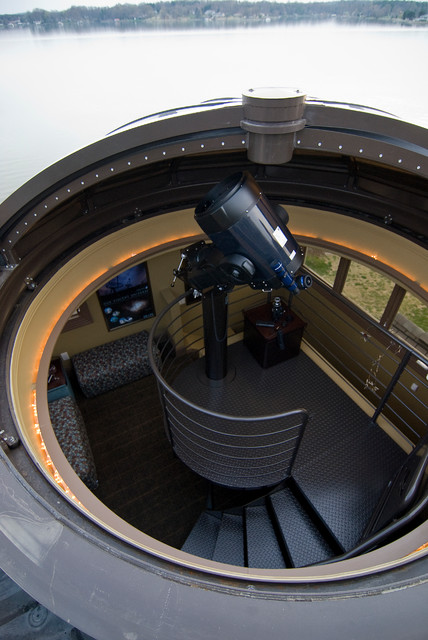
It'd be really cool to live in a house that used to be (or still is) an observatory. I could go to the dome and use the telescope at night, and when it isn't in use, it'd be a cool circular lounge room with a really interesting feature in the middle!

Observatory in the middle of a lounge room.
Credit: houzz.com

An example of an excellent house would be a recreation of the radio telescope out at Parkes otherwise known as "The Dish." I've been in there a few times (even on the dish!) and the space inside The Dish would be perfect for a house, it even has a kitchen and sleeping areas anyway, because while observing, astronomers basically live there! I imagine a house like that would be similar to living in a lighthouse. Lots of stairs, cylinder type building, and also really cool!

I think some of the observatories around the world are spectacular looking buildings and would be wonderful to recreate and live in.

 The list of pros about living in an observatory include: It's awesome, you have an observatory in your house, it's great for kids and learning about space, it's unique, you get heaps of nerd cred (very important). Compare that to the negligible amount of cons and you're on a winner.

I think with a small amount of imagination a home could be built to honour the observatory, as well as function as one. Sure there would be unique challenges, but every week on Grand Designs there are unique challenges. An observatory house would not be simply a cool design for the design sake, it would be a design that has a purpose. A lot of cases on Grand Designs are all about "The personification of the builders identity in bricks and mortar," well an observatory house is that for me, it tells you who I am and what I'm about.

They say that your house is your castle, I disagree. I think your house should be your observatory!

So I guess I'll get to my design then send it off to Kevin McCloud at the BBC so he can have a look at my bespoke (drink!) and unique design to see what he says. Until it actually happens though, I guess my little tabletop dobsonian and regular house will have to do.

Clear skies!

Friday, January 31, 2014

Why not treat scientists like footballers? Because they're not footballers!

I saw this from @sciengage in my twitter feed today and couldn't help myself but to add my opinion.
"Why not treat scientists like the highest paid footballers? They're doing a bit more than kicking balls around... bit.ly/1dbVmlF"

A nice article with some pretty good comments and discussion...But,

I don't think the argument is as simple as that. Should we should pay scientists more? or should we should treat scientists like celebrities? This is about equality, respect, trust, celebrity and effectiveness. In this post, i'll address each of those.

Equality
Of course I agree with paying scientists more. First up though, I'd extend this to all academics and researchers from any field. Academics certainly do contribute to society and should be rewarded for doing so. Then, if it's contribution to society, then we should also include teachers, garbo's, police to list only three. A call for more money for scientists will not make the problem go away. Either footballers would still get paid too much and the issue will get passed onto other fields, or scientists get paid too much, and the situatino is switched.

Respect
Granted, footballers are well respected amongst their fan base, but I certainly don't respect them when they abuse referees, hit their partners, drink too much an punch on... etc, no matter how much they get paid.

Trust
If it is a questions of "Should we trust scientists more than footballers?" We already do! Here is a small piece of analysis of Australia's most trusted people from last year. For the full list, go to http://www.readersdigest.com.au/australias-most-trusted-people-2013

Here's the top 11 for you
1. Charlie Teo, neurosurgeon
2. Fiona Wood, burns specialist
3. Ian Frazer, immunologist and cancer vaccine researcher
4. Chris Riley, founder of Youth  Off The Streets
5. Ian Kiernan, Clean Up  Australia founder
6. Mary, Crown Princess  of Denmark
7. Dick Smith, entrepreneur
8. Catherine Hamlin,  obstetrician and gynaecologist
9. Harry Cooper, TV vet
10. Hugh Jackman, actor
11. Karl Kruszelnicki, science journalist

The first three at the on the list I would consider as academics. I'd also ad din #8, #9 and of course #11. No Sports people! The first appearance of a sports person in the list is Libby Tricket (Swimmer) at #18, the first footballer of any kind is Lucas Neill at #49 (The only other footballers in the list are Essendon coach James Hird and Union player Quade Cooper #59 & #71)

Celebrity
There are indeed some super celebrity scientists out there. Some of them I can think of off the top of my dome are Dr Karl, Carl Sagan, Brian Cox, David Attenborough, Robert Winston, Bill Nye, Neil Degrasse Tyson, Michio Kaku, Adam Spencer. Richard Dawkins, Laurence Krauss, Brian Schmidt. And that's enough for a football team!

Do we really want to treat scientists like sportspeople anyway? I really don't think so. Spreading their image all over tabloids, fabricating stories about their personal lives, constantly hassling them for their opinions that have nothing to do with their field of research (and focussing only on that, not their amazing skill and work). I imagine that most scientists would probably prefer to be left alone to do their research, rather than be the focus of talkback radio shock jocks or papparazzi for example.

Scientists probably don't want that celebrity status, sure a bit of extra coin would be nice, but we could all use that!

Effectiveness
We should certainly not take away the skill, hard work, training, commitment and sacrifice that sportspeople make as well. Could a scientist kick a football around with absolute precision? Probably not (watch Nerds FC!!)

Science is not exactly a spectator event. A thrilling computer simulation just wouldn't get as many ratings as a down to the wire sport contest. We are entertained by sports, a major part of it's popularity is entertainment. That is not the case for science. We do not do science for entertainment, we do it to advance knowledge and make sense of the natural world. They are different, just different, so I think it would be ineffective to simply expect to make scientists into celebrities.

Conclusion
In principle I think the idea is good. Let's pay scientists more. Perhaps sportspeople do get paid too much, but the point is a little bit more complicated than that. In addition, I think the question should really be about if it's really a good move.

Now That'll do from me, the cricket's on!

I'm happy to discuss this further. There's heaps more in it!

Friday, January 24, 2014

SN 2014J

What a week for astronomy! Another example of why we should look up...even in London...on a cloudy night.

I tell students I talk to all the time that science can be done by anyone, even them. Next time you're in a classroom and something is odd, or not expected, have a look at what could be happening, because in some cases, like the discovery of a new supernova, it could be new science.

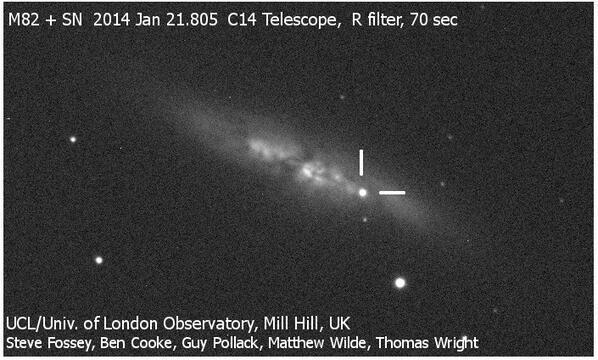
Supernova 2014J. It'll get brighter over the next couple 
of weeks.


Steve Fossey, an astronomer at the University College London was giving a quick 10 minute lesson to his students on the use of CCD cameras in astronomy, before the clouds in London rolled over. They pointed theirtelescope at the object M82, otherwise known as the cigar galaxy and saw something that "...didn't quite look right"
"One minute we're eating pizza then five minutes later we've helped to discover a supernova. I couldn't believe it," said student Tom Wright "It reminds me why I got interested in astronomy in the first place"
The more you look into this story the better it gets. I don't really want to report on all the things that have already been reported, but comment on the situation of students finding the Supernova, the unexpected circumstances and what to can mean for science, science education and awareness.

There is that old adage that scientific discoveries or less commonly followed by the phrase "I knew it" and more by "That's odd." That is almost certainly not exactly true, we scientists know what we are doing (especially if you read grant proposals!!) but we do see some strange results from time to time. Some people call it the Eureka moment, some call it frustrating, some call it their lifes work.


Hans Christian Oersted  immediately came to mind when I heard about the teacher discovering a Supernova this week. Oersted, in 1820, was lecturing on electric current through a wire, noticed that a nearby compass deflected when the current was switched on and restored to its original position when the current was switched off, making a link between electricity and magnetism. We take it for granted now almost.


I love the line "It reminded me why I got into astronomy in the first place. YES! Me too! It makes me want to go out right now and look up at the stars, but I can't because it's raining.  Although that just makes me want to get a radio telescope!

I hope this inspires a few people to one of a whole range of different things. 
  1. To consider science as a real living breathing thing that we are witnessing changing right now.
  2. That Astronomy is really exciting. Seriously, if it wasn't Steve Fossey and his students, it could've been anyone who discovered it
  3. Get involved in amateur astronomy, get a telescope, join a club even just look up and try and familiarise yourself with the night sky.
  4. Find out more and talk to others about Supernovae, or this event
This supernova is going to tell us a lot more than we already know about our universe and it is exciting to se it happen and see it talked about. I'm certainly going to keep my eyes open.

Unfortunately for us in the southern hemisphere, we wont be able to see it, but keep your eyes out in the blogosphere and news for some spectacular pictures. We have already asked those in the north to take some snaps for us, they said they'll do their best! And if you get inspired enough and you want to know more (formally), contact your local astronomer. I know a few, I can put you in touch!

Friday, January 17, 2014

Engagement vs education

I recently sent out an email alert to my colleagues at the University of Sydney School of Physics as an update of what's happening outreach-wise over the holidays and coming up. Among the events and news, were these two items: 

Astronomers collaborate with Artists to create a dance piece called AM I that is being premiered at the Sydney Festival. From all accounts, the show is extremely good! 
Academics from the School of Physics made some comments about the HSC physics syllabus that is being criticised as 'too arty' and the Board of Studies published in the Sydney Morning Herald on January 4. It's an interesting and thought provoking read. 

So, am I allowed to smile at a physics bulletin which starts by advertising a dance piece generated in consultation with the physics department and then highlights an article which criticises the change of HSC physics from a mathematics to an 'arts' subject:)? 

I was a little bit surprised when a response was sent back to me about the update that read: 

I took the comment as a bit of tongue-in-cheek fun, but I also saw an opportunity to start a conversation. This is a conversation I've been thinking about a while and would like to begin writing more about. For me, this was a great way to start! 

My response:   

You are of course allowed to smile, and after you mentioned it, I smiled too! And thanks for the different perspective!  

Physics will never be an arts subject, Science and arts work in very different ways and there are of course interesting overlaps. I see a distinction however, in collaboration and education. the news of Astronomers working with artists is all about awareness and the article about HSC is about education. 
Collaboration with the arts is in order to make people aware of the science, not understand the science. I see it as the ‘warm fuzzies.’ People who see that dance piece will walk away from it with a warm fuzzy feeling about astronomy and black holes to some degree, rather than being scared by the term. 

Whereas the HSC is more than awareness, it’s about education and understanding. The audience and objectives are different. I would hope that a student in the HSC can describe with some depth, use some equations, interpret graphs, make observations around the concept of black holes etc, that is, use the scientific method learnt from the HSC. I would not expect them to be able to dance a black hole, nor would I expect someone who has seen the dance piece top describe a black hole in any depth from only seeing that presentation.

Have you seen a program called dance your PhD? This is similar concept. Apart from being a bit of fun, it is a communication exercise, not designed to educate, but for awareness. In a way, any media article for example are similar. They are designed for awareness have a similar point, even some radio and tv shows, science centres for example. There are also many examples that blur the lines between engagement and education (Like the program I run, Kickstart)

To go for an extreme comparison...I’m sure you’d be able to tell the difference between playing the game Operation, and a medical degree!  

Now get involved  

What are your thoughts about public awareness of science vs public understanding if science. the next step is figuring out how to tackle public involvement in science, that is, getting people enrolled at uni, or TAFE, orin online courses, or reading science books or blogs etc. getting people to learn science themselves. 

Tuesday, January 7, 2014

Problem solving

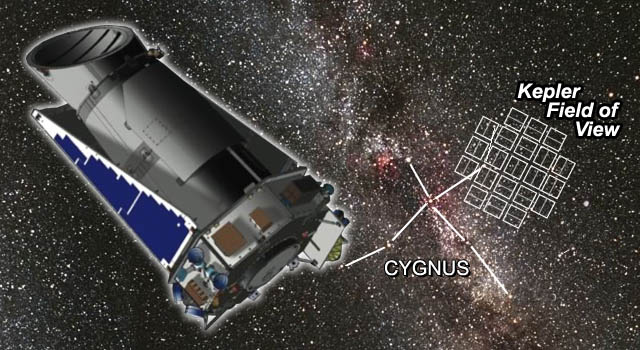
Kepler, and what it's looking at. Credit: NASA
I recently learnt that sometime late last year, the Kepler telescope suffered a pretty huge failure. Two of its four gyroscope reaction wheels, the things that keep it pointing so precisely at that dark part of the sky, have stopped working. A spacecraft needs at least 3 gyroscopes (one in each dimension of x, y and z) for stability and in Keplers case, these needed to be very sensitive in order to collect data from a long way of tiny measurements of light intensity, stellar conditions and asteroseismology.

Apparently on the telescope, there were two good gryos and two not so good ones. It was the not so good ones that failed, and we are left with two gyros left. But that still leaves the problem of on gyro down. The solution is to me a pure act of problem solving, and some great science and Physics to get to the solution.

I love the fact that a seemingly mission terminating failure occurs, but instead of accepting the failure, the mission scientists etc have simple changed the mission lightly to continue observing with only two gryos and possibly even making to experiment better. This is pure brilliance nd I am very lucky that I get to work with some of the people that make this project a reality

The pressure that the photons from the Sun exert on Keplers solar panels in fact give it a small push (very small), but over time, this will put strain on what was determined to be two not so good gryos, and once that have stopped working (friction etc) the solar pressure on the solar panels will push the telescope out of alignment, No mater what you do, you can not keep Kepler pointing at that one spot with only two gyros.

Credit: NASA
This solar pressure is a push, and if you break it down, a Gyroscope can be looked at as a push or a force too. So the idea is to use the solar pressure as a sort of third gyroscope on board the telescope. A brilliant idea, that makes me think that sort of backup plan has been though of all along. It also fills me with confidence that if another gyro goes, they've probably got a solution worked out for that too, if not, they'll certainly be tying to think of one now!

The exciting thing for me is that we'll now be able to look at 2 regions of space to find planets, potentially doubling the amount of planets to be found and gifting us with a comparison of two areas of space. In science we look for comparisons.

I love the fact that seemingly catastrophic failure has not only not been a failure, but cold keep on imaging and providing us with fantastic and meaningful results as well as potentially make the project better.

Scientists are problem solvers, this is what we're good at, it's why scientists are being employed all over the place ow and in some places that you wouldn't expect to see scientists. Financial institutions and the stock market for example. We have analytical brains and approach problems differently than lawyers for example. I'm not saying better, just different. This is a wonderful example of problem solving at it's best.