Wednesday, September 25, 2013

Spoiler alert, not to scale

A phrase has entered into our conversation and it annoys me. "Spoiler alert." grrrrr.

I think it's a completely unnecessary thing to say and it sort of treats the person you are talking to (or at least someone within earshot) with pretty large amounts of disrespect. If you really care that some one does not hear what you are about to say....don't say it.

Further, if you are the person that doesn't want to know...walk away. If you really don't want to know, make it so that you can't know! You can probably detect that something is coming up that you might not want to hear, so act on it.

It's a lazy way of saying either," I acknowledge your opinion but I don't care about it so I'm telling you so that you can't blame me", or "I'm not strong willed enough to keep this information from myself, and will choose to blame you for not respecting my desires." I've even noticed people saying it to themselves.

The other thing that we are saying a lot is "Not to scale." It is the scientific/misconception equivalent and again, it annoys me.

If something is not to scale...Why? and if not, make it to scale. It really isn't that hard to do. It also sort of depends on the scale that you are talking. The picture of planets and our Sun for example. It is to scale (if you are looking at sizes), but nearly every time I see this, someone says, "this is of course not to scale."
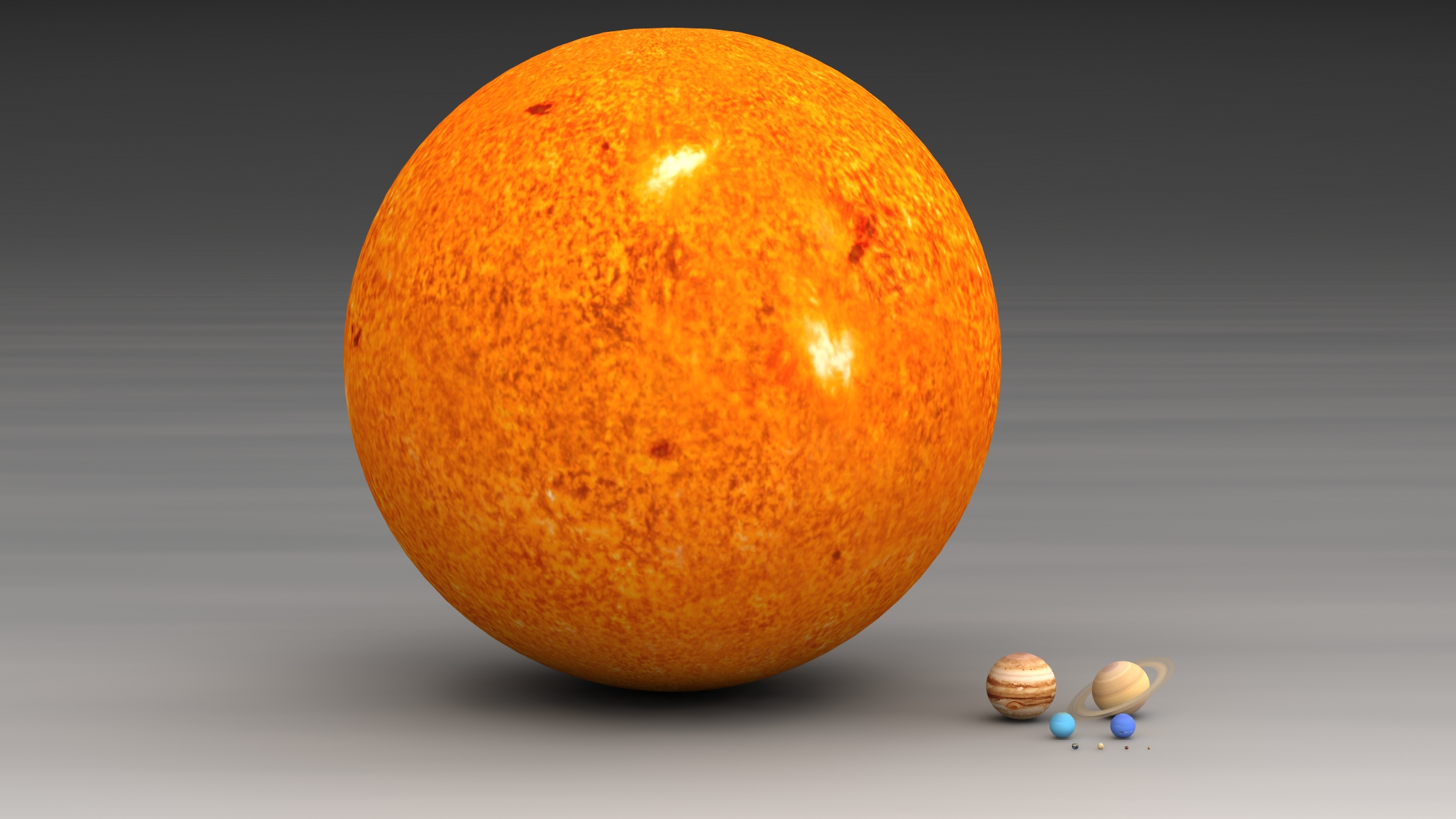
Exactly to scale
It's a cheap get-out-of-being-wrong card that I just don't like. "I'm right, but I'll cover myself so if I am wrong, I can say, I knew it and therefore be right about being wrong!"

Worse. You don't need to tell me that it's not to scale. I can sort of see that! Especially when we are talking about very large things like stars or universes, or very small things like molecules or atoms. I think the assumption can be made that what you are dealing with is things that are not to the scale of what they actually are. Or at least not a 1:1 scale.

When talking about a film or TV show or something and I know that someone is listening who might not want to hear. I won't say anything. If I did in error, and the person gets annoyed, I can always come back with, "hey, does it matter, it's a TV show!"or something.

When it comes to scales, we generally do explain or communicate things that are to scale, otherwise it would be useless to explain them that way.


Sunday, September 22, 2013

Teaching


As a teacher, I found myself on a few occasions teaching things like common sense, or how not to be foolish to some students more than science.

Teachers have an arsenal of classroom management techniques, some of mine included stopping what activity was being done and write things from the board, swapping groups, moving onto next activity, distraction, you know...the usual.

I realised however, that I was in a science classroom and I can use science to change the activity yet still using the topic or concept to say "Hey guys, get back on track," as well as "check this out, it's science, it's relevant"

Here are 3 examples of my science classroom management techniques where I got to investigate relevant science concepts as well as get the class back on task.

1. Peripheral vision
In a year 8 anatomy class, I noticed in my peripheral vision, some students were being less that model students. I stopped the activity and got them all to sit down. I asked the students to show me their best spirit fingers with their hands either side of their head about where their ears are, so that they couldn't see their hands. I asked the slowly move their hands forward (while still giving it some sparkle) until they could see their hands still looking forward.


Firstly, it is pretty amusing to see a whole class of year 8 students doing spirit fingers, and secondly, they have instantly realised that their peripheral vision is quite wide...and so is mine! I barely had to mention the fact that I could see what those students were doing. The message was effective and I got to talk about science in the process.

2. Total internal reflection
Very similar situation, but instead of using jazz hands, I used the door to the classroom that had a large glass panel in, opened in a way such that through total internal reflection, I could see what some of the students were up to. So, in a physics class on the properties of light, I could stop the class, talk about total internal reflection, then simply turn to the door and wave at the students behind me reflected from the door. Again, I didn't even need to mention the classroom management point of the excersise, that was fairly obvious, and so was the scientific one.

3. Waves
This technique wasn't really about showing the students they had done something wrong, just disrupting their disruptive behaviour. In the waves topic, I would get the students to create a mexican wave in class, complete with shouting etc! The beauty of this is that there are heaps of things like reflection, interference, refraction, speed, transverse vs longitudinal that you can do with waves. So each time I had to use the technique (which worked in terms of classroom management) I got to talk about something else to do with waves, and build upon what they had 'learnt' from last time.

I found myself looking to relevant scientific principals to make an educational point as well as a behavioural one. I think it worked too. The students would mess up less cos they weren't getting the usual teacher reaction and everyone involved got some unexpected science!

Monday, September 16, 2013

Standing waves

I like to see physics in strange places. Last week I took my kids to the local swimming pool and was mucking around in the kiddie pool with my youngest (he's 2). His mind was occupied with throwing a toy clown fish (he calls it Meemo, and I have to try and fight the urge to say "Found him"every time he throws it!) and the retrieving it again. So I tried a little experiment, and this one surprised me!

I talk about standing waves almost everyday to students that come through the Kickstart lab. It is such an important concept in Physics that I think I can spend a few minutes on what they are and how to make investigate them.

A standing wave is essentially 2 waves. both that interact with each other to create constructive and deconstructive interference. The result is a wave that seems not to move. The features and characteristics of a standing wave are different to that of a normal wave. A normal wave has a peak and trough, a speed you can measure by measuring it's distance travelled over time etc. A standing wave does not have these features. It has a node which is the bit in the middle that doesn't move, and the peaks and trough (they are the same thing) are called anti-nodes.

To create a standing wave, all you need to do is reflect a wave of a rigid surface (like the wall in this case) that is the same wave in the opposite direction.

Simple.

The cool bit was when I tried this in a swimming pool. You can make a wave in the pool with your hand, just move your hand through the water (close to the surface I guess) and you've got your wave. If you do the same with your other hand in the opposite direction you get interference.

This interference is the standing wave, and this is cool enough! but it gets cooler! I was mucking around with tis in the pool and looked up to see my son still throwing Nemo about and I caught in my peripheral vision the waves that I had created were still going long outside of where my hands created them, but they were not standing waves anymore. The brilliant thing about this is that I could see that my hands were creating separate waves that travelled along in their respective directions, it was only when they were interacting (between my hands) that they created a standing wave.

A very simple illustration of the complex physics of standing waves, that any one can do, and probably has done before. I love it, and next week when we go back to the pool, I'll be repeating my experiment while my son throws fish.


Wednesday, September 11, 2013

Do you get frustrated over time when trying to understand graphs?

Graph-iti
Here is my attempt at explaining graphs in Physics, and what they are for.

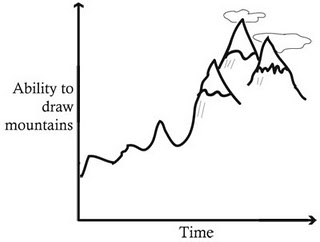
Ability to draw mountains over time
Graphs are really important. My opinion is that if a picture is worth a thousand words, then a graph can be like a whole thesis! I'll start with a very funny graph made by an excellent comedian Dmetri Martin. His graph (My ability to draw mountains over time) is a wonderful description of what a graph is an how it is helpful. It's at least a very good joke. Dmetri has had to understand what a graph is in order to make the joke, and to get it requires a similar mastery of graphing too.

You can tell that as time gets larger (that is as we move further away from time zero in this experiment) Dmetri's ability gets better. The thing that changes in this experiment is time so we put that on the x-axis and plot the thing we are measuring against the thing that changes on the y-axis. We can call these the independent and dependant variables if we like, but I wont. We could even start to make some predictions about Dmetri's mountain drawing abilities for some time further down the track, or we could draw a line of best fit through his data points in order to get an equation for his graph.

I see this as one of the main points for doing Physics. We do it to get data points that we can tabulate. Then we graph the tabulated data and from that graph, make predictions and fit equations. Once we have the equation for the graph, then we don't have to do the experiment again and in fact we can rearrange or manipulate the equation for our purposes.

Most equations we see have come from an experiment that tabulated and then graphed. When you look at a graph as simply an expression of tabulated data, or a pictorial representation of an equation, they start to make a lot more sense.

Hertzsprung-Russell Diagram
One of my favourite graphs is the astronomers version of the periodic table of the elements called the H-R digram. The H-R diagram plots the intensity of a stars light against it's colour or temperature. What this graph says to us is that the hotter the star is, the bigger it's intensity will be, makes sense right? Of course!

This graph however, is so much more than that. We know that stars evolve and as they get older they change their composition therefore change their temperature, which in turn will change their luminosity. This effectively means that the HR diagram is a plot of the life cycle of star. I can make predictions too. Tell the colour or luminosity of a star and I can tell you what sort if star it is and wether it is likely to go Supernova in it's lifetime or not. Pretty cool little graph.

I use graphs all the time to convey messages, i think they hold an immense power to communicate an experiment or outcome. If maths and equations are the language of Physics, then graphs are its poetry.


Wednesday, June 12, 2013

Where are the other communicators?

Here's something I have always wondered. Why are there no law communications summits, or courses in finance communications, or blogs about philosophy communications? Why is it that only science communication is a thing?

I'm not complaining, obviously due to the fact the science communication is my job, but really, why is there no politics communication? Is science communication special? Is that a deluded question?

Why is there a need to communicate science. Are we that bad at science that we have to have people who are trained in telling others about it? Should we really have to celebrate scientists that are good at science communication? There are too many questions here, but I'm afraid I don't really understand, so I may as well ask more.

Communications is a thing, I get that, is science communication simply under that umbrella? If so then why do we separate ourselves from those conferences or faculties etc? We call ourselves science communicators which implies that we really do specialise in the communication of science and not other things. I would certainly not like to claim to be an expert on communications communication.

Being a science communicator for me, is a wonderful and fulfilling job. I love it. I have never worked so hard in my life, but also, have never enjoyed my work so much. I love my job. I get to walk the corridors of a world leading Physics School past some of the greatest minds I'll ever know, and talk with them about what they do, and I do absolutely consider it a privilege that my role is to then talk about their work to others.

But why is that my role? Why would I never meet someone who does my job for teachers, or for mechanics? (again, not complaining). Perhaps scientists are terrible at communicating. Or perhaps every other discipline hasn't thought of it yet, and we will start to see some music communicators or sculpture communicators. Or something else entirely.

Have I got this completely wrong?

Friday, June 7, 2013

What's the plan?

Day 2 at the Big science communication summit has got me to think about what I'll do. That's the point of a conference right?

1. Make YouTube videos of research
I'll try and get researchers to do it, firstly by example, and also encourage things like dance your PhD. I think this is a great idea, well worth a try, if nothing else it'll build a pool of resources.

2. Encourage social media
I like the idea of having people do this on their own but supported and championed by our institutions. I'm not going to force a Uni twitter account, or change much what happens on our Facebook page etc, but find ways use social media the way it is designed. As a social network of interconnected things, not a forced, uncool activity for the sake of appearances.

3. Not let momentum in science communication fall. this includes me contributing to that from my institution. What I'd really like to start pushing for is a stronger representation of science communication in teaching and learning at University. There aren't many places that do this and I don't know why. I'll be thinking ,and talking with others, very seriously about programs in science based science communications. Program's for students, postgrads etc. there are standards we have to cover on this, and like it was said, every job that we apply for, will have some sort of communications role.

Interesting ideas to think about.
1. Viral media attempts. Inspired by the Baw Baw, this is pretty easy from physics. Astronomy is a bit of a gimme!
2. Science based Q&A-style show, or panel show. There are heaps of formats to choose from. The panel, Q&A, spicks and specks... This doesn't have to be a tv show by the way. Google+ hangout can be a format.
3. And y'know, heaps of other stuff!

Thanks heaps!

Thursday, June 6, 2013

Whats the lesson?

Things I learnt from today.

I was at the science rewired Big Science Communication Summit today and have a few thoughts and comments about the sessions, speakers and conversations. Heres my top 3:


1. Collaboration. This sort of implies that we dont have to go about all this by ourselves. My job is science communicator, but that doesn't mean I have to do it all. I've been worried about this a little bit lately. I used to think that there are heaps of people better at scicomm than me, but I've now realised that instead of being better, they are complimentary to what i do and what we all do. We can't do it all by ourselves, and neither should we be expected to. I'm a big supporter of collaboration. We tell students all the time that scientists collaborate. So...we are scientists, we should collaborate more!

2. Social Media. This one gets thrown around a lot and it worries me that we keep talking about it but not a lot seems to be done. It is very hard ot have a social media presence in a place like a University that has a brand, guidelines, etc. I dont think we should force people to get into social media. As an ex-teacher, I can tell you that as soon as you tell someone what is cool and what they should be doing, it is instantly UN-cool and not worth doing. We shouldn't make people tweet, we shouldn't even make Universities tweet, or blog. What we should do is embrace their voice if they do. There are a number of excellent social media savvy people that I work with, and their following is far greater than any institution could drum up. I don't think we should be afraid of that. Social media should be organic. People can tell when places like universities try too hard.

3. This sentence "what happened to climate science can happen to any other form of science." - Alvin Stone. This got me right in the feels. We have to be careful and we have to be good. The graph that showed perceived trends from scientists and non scientists was a great illustration, imo, of what we were all talking about today (and I'll post it here when I find it). I love graphs, and I love it that it was a graph that floored me.

What I expected to see was a bit more coverage of research based science communication. To fully advance our field of scicomm as a science, we should embrace scicomm research, which we do I think, I just didn't see much of it today, maybe I wasn't paying attention!


In addition, I got to see some old friends and chin wag for a little bit, make some new friends and even a little bit of professional networking. Finally, the great day was finished up by some wonderful cuddles by my family and a yummy lasagne dinner! A great day, looking forward to tomorrow.